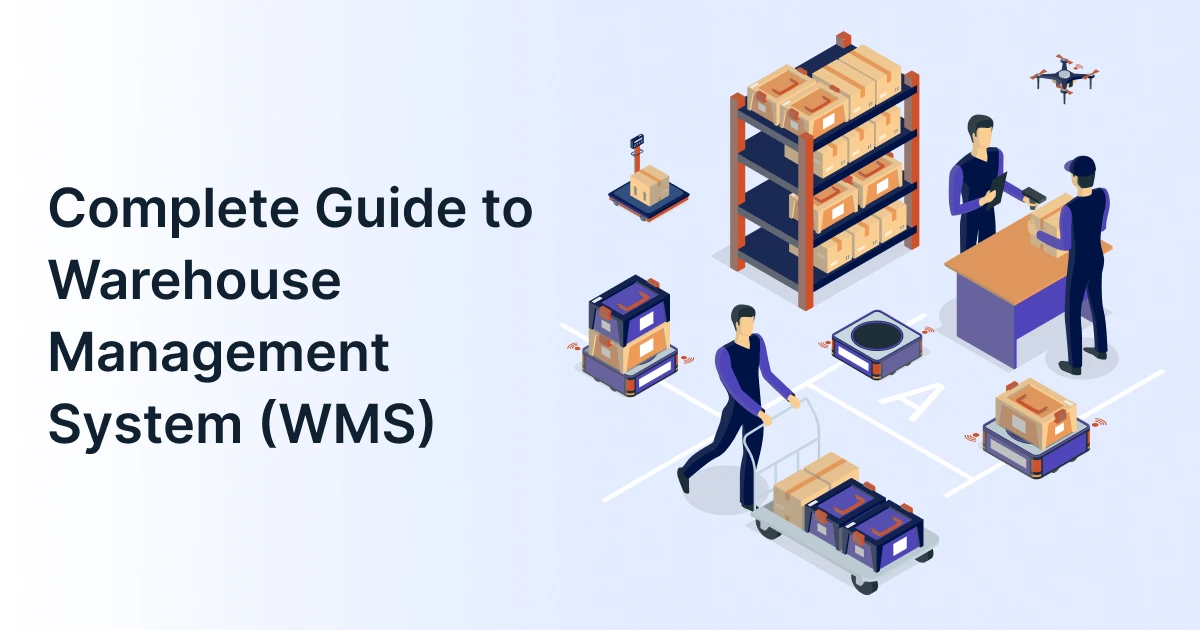
Complete Guide to Warehouse Management System (WMS)

Warehouse operations have changed dramatically over the last decade. Customers expect faster deliveries. Supply chains are more complex. Inventory moves across multiple channels, and warehouses are under constant pressure to do more with less space. That is why a warehouse management system has become a critical technology investment for modern businesses.
Whether you run an e-commerce warehouse, manufacturing facility, distribution center, wholesale operation, or 3PL business, managing inventory manually is no longer sustainable. Errors multiply. Costs increase. Customer satisfaction drops.
A modern warehouse management system helps organizations gain complete visibility across warehouse operations. It improves inventory tracking, automates workflows, reduces picking errors, and supports business growth without requiring proportional increases in labor.
In this guide, we’ll explore everything buyers need to know about WMS, from warehouse challenges and business benefits to implementation, evaluation, and selection.
At GrexPro, we work with organizations that want smarter and simpler cloud-based operational systems. As supply chains continue to evolve, businesses need solutions that help them move faster, stay accurate, and remain competitive.
Key Takeaways
- A warehouse management system helps businesses manage inventory, storage, picking, packing, and shipping operations.
- Modern WMS software improves inventory accuracy by up to 99% when properly implemented.
- Warehouse automation reduces manual work and operational costs.
- Cloud-based warehouse management software offers faster deployment and lower IT overhead.
- WMS and ERP integration create end-to-end supply chain visibility.
- Businesses should evaluate scalability, integrations, reporting, and usability when selecting a solution.
- AI, automation, robotics, and predictive analytics are shaping the future of warehouse operations.
What Is a Warehouse Management System (WMS)?
A warehouse management system is software that controls, tracks, and optimizes warehouse operations from inventory receipt to shipment.
It provides real-time visibility into stock movement, inventory levels, storage locations, labor performance, and order fulfillment activities.
In simple terms, a warehouse management system helps businesses know what inventory they have, where it is located, and how efficiently it is moving.

Key Functions of a Warehouse Management System
WMS features coordinate warehouse activities using real-time data. It manages receiving, putaway, inventory tracking, picking, packing, shipping, and replenishment. Every inventory movement is recorded automatically. This creates a single source of truth across warehouse operations.
Here are a few key activities a WMS does on a day-to-day basis:
- Inventory Visibility: Tracks inventory across locations in real time.
- Receiving Management: Aligns inbound goods processing.
- Putaway Optimization: Suggests optimal storage locations.
- Barcode Scanning: Improves inventory accuracy and speed.
- Order Picking: Guides workers through efficient pick routes.
- Packing Control: Ensures order accuracy before shipment.
- Shipping Management: Coordinates carrier and dispatch processes.
- Labor Tracking: Measures workforce productivity.
- Reporting & Analytics: Provides operational performance insights.
Importance of WMS
The importance of WMS branches to different fields today. We can see that customer expectations have shifted dramatically in the recent days. Thus, businesses must fulfill orders faster while maintaining accuracy and controlling costs.
A modern warehouse management system helps organizations meet these expectations without increasing operational complexity.
What Problems Does a WMS Solve?
Many warehouses struggle with visibility. Teams often deal with manual spreadsheets, inventory discrepancies, delayed shipments, and inefficient storage utilization. A WMS addresses these challenges through automation and real-time tracking. We’ll learn more about the challenges later in this blog.
To sum up, a warehouse without a WMS is like driving a vehicle without a dashboard. In such scenarios, you are moving, but definitely with a limited visibility. Let’s look at a descriptive chart about the same.
Manual Warehouse vs Warehouse Management System
| Capability | Manual Process | Warehouse Management System |
| Inventory Accuracy | Low | High |
| Stock Visibility | Delayed | Real-Time |
| Order Picking | Paper-Based | Digital |
| Labor Productivity | Inconsistent | Optimized |
| Error Tracking | Difficult | Automated |
| Reporting | Manual | Real-Time |
| Scalability | Limited | High |
| Warehouse Automation | Minimal | Extensive |
According to Gartner, supply chain leaders continue to prioritize warehouse digitization initiatives to improve operational resilience and efficiency.
Source: Gartner Supply Chain Research
Why Do Businesses Need a Warehouse Management System?
Businesses need a warehouse management system because warehouse complexity grows faster than revenue growth. As product lines, customers, and order volumes increase, manual processes become expensive bottlenecks.
A WMS creates structure, visibility, and efficiency that support sustainable growth. Let’s see what happens without a WMS.
Common Challenges Warehouses Face Without a WMS
We’ve mentioned earlier that manual operations create hidden costs. Inventory inaccuracies, delayed shipments, excess inventory, and employee inefficiencies become common challenges. Over time, these issues impact profitability and customer satisfaction. Key challenges are:
- Missing Inventory: Without real-time tracking, stock loss becomes a daily phenomenon, and inventory management becomes difficult.
- Delayed Order Fulfillment: Without automated workflows, operations are disturbingly slow.
- Excess Labor Costs: Without process optimization, labor productivity decreases, which in turn increases costs.
- Poor Space Utilization: Without smarter storage allocation, warehouse capacity minimizes on a daily basis as many corners are left unused or overlooked.
- High Return Rates: Decreased order accuracy increases fulfillment mistakes.
- Inventory Write-Offs: Poor visibility maximizes obsolete stock.
- Lack of Reporting: Lack of dashboards means lack of actionable insights. This again results in loss of control.
- Multi-Channel Complexity: Decentralized control lacks the support of omnichannel operations.
How Does a WMS Improve Inventory Accuracy?
Inventory accuracy is the foundation of warehouse performance. A WMS captures inventory movements in real time through barcode scanning, automated workflows, and digital tracking.
This significantly reduces stock discrepancies.
How Does WMS Improve Customer Experience?
Customers want accurate and timely deliveries. A WMS helps businesses fulfill orders correctly and faster while maintaining visibility throughout the process.
Better service leads to stronger customer retention.
What Are the Financial Benefits?
Operational efficiency directly impacts profitability. Businesses often experience lower labor costs, reduced inventory carrying costs, fewer errors, and improved inventory turnover.
For businesses evaluating integration opportunities, knowing about the financial benefits of WMS ERP integration can provide additional insights.
Most warehouse issues are not inventory problems. They are visibility problems, and WMS brings that visibility.
According to Deloitte’s Future of Distribution Centers research, organizations increasingly invest in automation, real-time visibility, and intelligent warehouse technologies to support growing fulfillment demands.
Source: Deloitte Future of Distribution Centers Report
How Does Warehouse Management Software Drive Warehouse Automation?
Modern warehouse management software acts as the operational brain behind warehouse automation. It connects people, processes, inventory, and technology in one platform. Without software intelligence, automation tools cannot achieve their full potential.
What Are The Key Decision Support Capabilities?
A warehouse management system sends instructions, tracks execution, and validates inventory movements. Let’s see some of the key activities:
Demand-Based Replenishment
A WMS continuously monitors inventory levels and automatically identifies when stock is running low. This helps maintain optimal inventory availability while avoiding costly stockouts or excess inventory.
- Reorder Point Tracking: Monitors inventory thresholds and triggers replenishment at the right time.
- Demand Pattern Analysis: Identifies fast-moving products based on historical demand.
- Stock Availability Control: Ensures critical items remain available for order fulfillment.
Demand-based replenishment helps warehouses maintain the right inventory levels without overstocking or running out of essential products.
Labor Performance Monitoring
Warehouse labor is one of the highest operational costs and one of the most important productivity drivers. A WMS provides visibility into workforce performance so managers can identify bottlenecks and improve efficiency. Hence, the cost of warehouse management software is far less than the financial loss caused by poor labor performance.
- Task Performance Tracking: Measures picking, packing, receiving, and putaway productivity.
- Workload Visibility: Shows where workloads are uneven across teams.
- Resource Optimization: Helps assign employees to tasks where they can be most productive.
Labor performance monitoring helps businesses maximize productivity while making better use of their workforce.
Exception Management
Even well-run warehouses experience unexpected issues. The challenge is identifying them before they affect customers. A WMS alerts teams to exceptions in real time, allowing faster corrective action.
- Inventory Discrepancy Alerts: Flags stock mismatches before they become larger problems.
- Order Fulfillment Notifications: Highlights delayed or at-risk orders.
- Process Deviation Detection: Identifies workflow disruptions that require immediate attention.
Simply put, exception management reduces operational surprises and helps teams resolve issues before they impact service levels.
Operational Reporting
Warehouse activities generate large amounts of data every day. A WMS transforms this data into meaningful reports that support operational and strategic decisions.
- Performance Dashboards: Provide visibility into key warehouse KPIs.
- Trend Analysis Reports: Reveal recurring patterns and improvement opportunities.
- Data-Driven Decision Support: Helps managers make informed operational choices.
Operational reporting turns warehouse data into valuable business intelligence that supports continuous improvement.
Forecasting Support
Warehouse planning becomes significantly easier when decisions are based on historical trends rather than assumptions. A WMS helps businesses anticipate future inventory and operational needs more accurately.
- Demand Forecasting Insights: Uses past order patterns to predict future demand.
- Capacity Planning Support: Helps prepare warehouse resources for growth and seasonal peaks.
- Inventory Planning Guidance: Improves purchasing and stocking decisions.
Forecasting support helps businesses stay ahead of demand changes and prepare warehouses for future growth with greater confidence.

What Role Does AI Play in Modern Warehouses?
As we have seen, most warehouse teams already have so much on their plates. Inventory levels change daily, orders keep coming in, and one unexpected spike in demand can throw everything off track. That’s where AI starts to make a difference.
Instead of spending hours digging through reports, managers can use AI to spot trends, predict demand, and make better decisions before small issues turn into bigger problems. It can suggest where products should be stored, help plan staffing for busy periods, and even highlight patterns that humans might miss.
The best part? AI isn’t there to run the warehouse. It’s there to give teams better information, so they can work smarter, react faster, and stay one step ahead.
Want to see how this works in practice? Check out how AI is transforming warehouse management systems.
What Technologies Work With WMS?
Many emerging technologies integrate directly with WMS platforms. These integrations create smarter warehouse ecosystems.
Let’s see the warehouse automation technologies in detail.
Barcode Scanning
Manual inventory updates sound manageable until order volumes start increasing and mistakes begin piling up. With barcode scanning, warehouse staff can record inventory movements in seconds instead of stopping to enter information manually.
The result is cleaner inventory records, faster warehouse operations, and much greater confidence in the stock data everyone relies on.
Mobile Devices
Most warehouse delays don’t happen because people aren’t working hard. They happen because information takes too long to catch up with what’s happening on the floor. Mobile devices help close that gap. As soon as inventory is picked, received, moved, or counted, the update can happen right then and there.
Everyone sees the same information, which makes coordination easier and keeps operations moving without unnecessary hold-ups.
RFID Technology
Some inventory just doesn’t sit in one place for very long. It moves from receiving to storage, from storage to picking, and then out the door.
RFID makes it easier to keep up with all that movement. Instead of relying on manual checks, teams can see where products have been and where they are now.
The result is fewer inventory mysteries, fewer stock discrepancies, and much more confidence in what’s actually sitting on the shelves.
Voice Picking
Picking might sound simple in theory. However, in reality, workers are often moving quickly through aisles while trying to keep up with order volumes and accuracy targets.
Voice picking removes the need to constantly look at handheld screens or printed pick lists. Workers receive instructions through a headset and can focus on finding, picking, and moving items.
It feels more natural on the warehouse floor. Less stopping, less checking screens, and a smoother workflow when orders start piling up.
Automated Storage Systems
Warehouse space has a funny way of disappearing. One month there’s plenty of room, and the next, every aisle feels crowded and every incoming shipment becomes a storage puzzle.
Automated storage systems help make better use of the space that’s already available. Instead of relying on fixed storage habits or manual decisions, inventory can be stored in a more organized and efficient way.
The real benefit isn’t just fitting in more products. It’s being able to find, access, and move inventory faster without turning the warehouse into a maze.
Autonomous Mobile Robots
In many warehouses, the longest journey isn’t through the supply chain, it’s across the building. One item needs to go to packing. Another needs replenishment. A third needs to be staged for shipping. Before long, employees have walked miles without actually completing much value-added work.
AMRs quietly take those errands off the team’s plate, reducing the endless warehouse marathon and helping work get done a little faster without everyone rushing around.
AI Analytics
Every warehouse has that one manager who seems to know exactly what’s going wrong before anyone else notices. AI analytics is a bit like having that person on the team, except it’s constantly looking at thousands of warehouse transactions, order patterns, and inventory movements all at once.
Sometimes the biggest problems don’t arrive with a warning sign. Orders start taking a little longer. A particular product keeps running out. One area of the warehouse becomes an obstacle. AI helps spot those trends early, when they’re still easy to fix.
IoT Sensors
Most warehouse disruptions don’t come out of nowhere. There are usually warning signs long before something goes wrong. Maybe equipment starts behaving differently. Maybe inventory conditions change. Maybe a process begins slowing down little by little.
IoT sensors help capture those signals as they happen, giving warehouse teams more visibility into daily operations and fewer unpleasant surprises to deal with later.
What we learned in this section is that automation without intelligence creates activity. Automation with a WMS creates measurable business outcomes.
Here are a few common examples to give you a better idea about warehouse automation.
- Amazon: Uses advanced warehouse automation and intelligent inventory management systems to support rapid order fulfillment.
- Walmart: Leverages automated distribution centers and technology-driven inventory visibility across its supply chain.
- DHL: Deploys robotics and AI-enhanced warehouse operations to improve productivity and customer service.
These examples highlight how technology-driven warehouses can scale efficiently while maintaining accuracy.
How Do You Choose the Right Warehouse Management System?
The right warehouse management system depends on business needs, operational complexity, growth plans, and integration requirements. There is no universal solution. The best WMS aligns technology capabilities with operational goals.
Important Features Buyers Should Look For
Organizations should focus on functionality that solves current challenges while supporting future growth. Scalability is just as important as immediate operational improvements. Important features to look for:
| Scalability | Cloud Architecture | ERP Integration | Real-Time Inventory Visibility | Mobile Accessibility |
| Automation Readiness | Reporting & Analytics | Multi-Warehouse Management | Barcode Scanning Support | RFID Compatibility |
| Inventory Tracking & Control | Order Management | Receiving Management | Putaway Management | Replenishment Management |
| Picking Optimization | Packing Management | Returns Management | Cross-Docking Capabilities | Labor Management |
| AI & Advanced Analytics | Demand Forecasting | KPI Dashboards | Custom Alerts | Business Intelligence Tools |
| Workflow Customization | Warehouse Automation Integration | API Availability | E-commerce Integration | Carrier Integration |
| Role-Based Access Controls | Security & Compliance | Audit Trail & Traceability | Disaster Recovery | Vendor Support & Training |
Choose Cloud-Based WMS
Cloud-based WMS has become the preferred choice for many businesses. It offers faster implementation, lower infrastructure costs, stronger accessibility, and easier updates. This aligns with GrexPro’s cloud-first approach to modern business technology.
Look for Integrations
A WMS should not operate in isolation. Integration with ERP, transportation, procurement, accounting, and e-commerce systems creates end-to-end visibility.
Questions Buyers Should Ask Vendors
Decision-makers should evaluate both technology and long-term partnership capabilities. The goal is sustainable operational improvement, not merely software deployment. So, the important questions to be asked are:
- How long does a typical implementation take?
- What is the typical ROI timeline for customers similar to us?
- What does the product roadmap look like for the next 2–3 years?
- What are the total costs beyond the subscription or license fee?
- What training resources are provided for warehouse teams?
- What security measures and access controls are available?
- Are dashboards customizable for different user roles?
- Can the platform support multiple warehouses and locations?
Make a decision only after getting satisfactory answers to all the above questions.
The best WMS is not the one with the longest feature list. It is the one that solves your warehouse challenges most effectively.
WMS Selection Comparison Table
| Evaluation Criteria | Basic Warehouse Software | Advanced WMS Software |
| Inventory Tracking | Basic | Real-Time |
| Automation Support | Limited | Extensive |
| Analytics | Standard | Advanced |
| ERP Integration | Partial | Comprehensive |
| Scalability | Moderate | High |
| AI Capabilities | Minimal | Growing |
| Mobile Functionality | Limited | Full |
| Multi-Warehouse Support | Basic | Advanced |
Where Does WMS Fit in the Modern Buyer’s Journey?
Most buyers do not start by searching for software. They start by experiencing operational pain. The journey typically progresses from problem recognition to solution evaluation and purchase confidence. Let’s go through the journey step by step.
Awareness Stage
Here, the buyers identify the problem. Organizations gradually notice recurring issues. Inventory inaccuracies, delayed deliveries, warehouse congestion, and rising labor costs become visible symptoms. Here, you also get signs such as:
- Growing order volumes where manual processes become overwhelmed.
- Inventory discrepancies where accuracy levels start declining.
- Customer complaints due to service expectations not being met.
- Labor challenges where operational costs continue rising.
- There are expansion plans but no proper scalable systems.
- You have multiple warehouses where visibility becomes increasingly difficult.
For optimization strategies, businesses can explore the best practices for warehouse space optimization
Consideration Stage
In this stage, the buyers start exploring solutions. Decision-makers begin evaluating available technologies. They compare spreadsheets, legacy systems, standalone warehouse software, and integrated WMS solutions.
Decision Stage
This stage is all about selecting the right platform. Buyers prioritize scalability, integration, usability, and ROI. They seek evidence that the solution can support long-term growth.
For e-commerce businesses, warehouse management system for E-commerce growth provides additional considerations.
Future Planning Stage
Here, organizations increasingly evaluate emerging technologies. For example, industry leaders are exploring automation, AI, robotics, and predictive analytics.
Businesses preparing for future transformation should learn how to capitalize on warehouse automation trends without breaking your supply chain.
Thus, the right time to invest in WMS is usually before warehouse complexity becomes a crisis.
How GrexPro Helps Modern Businesses Simplify Warehouse Operations
Most businesses don’t start looking for a WMS because they want new technology. They start looking because inventory is harder to track than it used to be. Orders start increasing suddenly. Teams still rely on spreadsheets. And warehouse processes that once worked fine, eventually starts to show loopholes.
GrexPro helps businesses move beyond those growing pains with cloud-based solutions designed for real-world operations. By connecting warehouse processes with the wider business ecosystem, we help teams spend less time chasing information and more time making informed decisions.
Because when operations become simpler, growth becomes easier.
According to research from McKinsey & Company, warehouse leaders are accelerating investments in automation, robotics, AI, and advanced analytics to address labor shortages and improve fulfillment performance.
Source: McKinsey & Company Supply Chain Risk Survey
Another research from PwC supply chain surveys also indicates that digital supply chain technologies continue to be among the highest-priority investment areas for operational leaders.
Source: PwC Digital Supply Chain Research
These researches only prove how modern businesses and industry leaders are changing their perspectives on warehouse management systems and how automation is becoming a non-negotiable part of it.
Conclusion
The modern warehouse demands more than manual tracking and disconnected systems. A robust warehouse management system creates real-time visibility, improves inventory control, boosts productivity, and supports long-term growth.
As order volumes rise and customer expectations evolve, businesses need technology that simplifies complexity rather than adding to it. The best WMS solutions combine visibility, automation, intelligence, and scalability.
For organizations looking to build future-ready operations, investing in the right warehouse management system is no longer optional. It is becoming a competitive necessity.
FAQs
Q: What is a warehouse management system?
A: A warehouse management system is software that controls inventory, warehouse processes, order fulfillment, and inventory movement in real time.
Q: What is the difference between ERP and WMS?
A: ERP manages broader business operations, while WMS focuses specifically on warehouse and inventory activities.
Q: Who needs WMS software?
A: Manufacturers, distributors, wholesalers, retailers, e-commerce businesses, and logistics providers can all benefit from WMS software.
Q: Can small businesses use warehouse management software?
A: Yes. Modern cloud-based solutions make warehouse management software accessible and cost-effective for growing businesses.
Q: How long does WMS implementation take?
A: Implementation timelines vary based on complexity, integrations, data migration, and operational requirements.
Q: Does WMS support warehouse automation?
A: Yes. Modern WMS systems integrate with barcode scanners, RFID, robotics, automated storage systems, and AI-driven technologies.
Q: What are the biggest benefits of warehouse inventory management?
A: Improved inventory accuracy, reduced costs, faster fulfillment, better customer service, and enhanced operational visibility.
Q: Is cloud-based WMS better than on-premise software?
A: For many businesses, cloud solutions provide greater flexibility, scalability, faster deployment, and lower maintenance requirements.
Author
Managing Director of Grexpro
Surendra Yarrum is a Business Strategist at GrexPro with expertise in ERP, CRM, and warehouse management systems, helping businesses enhance efficiency and optimize supply chain operations.