
 2nd April 2026
The Financial Benefits of WMS ERP Integration
Summary:
Integrating your Warehouse Management System (WMS) with your Enterprise Resource Planning (ERP) platform is a vital margin-protection strategy. This post breaks down the catastrophic financial leaks caused by disconnected systems, from phantom inventory to delayed wholesale shipments. By the end, you will have a clear framework for how real-time data syncing eliminates operational friction, reduces out-of-stocks, and gives your executive team the visibility required to scale profitably.
The Financial Benefits of WMS ERP Integration
Picture this. Your wholesale team just closed a massive Q3 order with a major department store. The contract is signed, the ERP registers the revenue, and congratulations are passed around.
But on the warehouse floor, the reality is entirely different.
Your warehouse management system hasn’t received the updated allocation yet because the systems only sync via a batch upload at midnight. Meanwhile, your e-commerce channel continues to pull from that exact same inventory pool. By Tuesday morning, you have oversold your top-performing SKU by 4,000 units. Now, you face chargebacks from the retailer, canceled online orders, and a deeply stressed customer service team.
Disconnected infrastructure actively sabotages your operations.
Operating a global brand with isolated data silos creates a cascade of invisible costs. In this breakdown, we will examine the financial anatomy of these failures and outline the exact operational benefits of seamless WMS ERP integration.
Streamline Operations & Drive Smarter Growth
Looking to optimize workflows, reduce inefficiencies, and scale faster? Discover how GrexPro’s intelligent solutions can transform the way your business works.
The Anatomy of a Disconnected Supply Chain
Consider this operational autopsy of a mid-market apparel brand managing omnichannel fulfillment. As noted in a Supply Chain Dive analysis on inventory disasters, many companies hit a breaking point when relying on legacy ERPs and disconnected fulfillment systems. The brand relied on an older ERP for financials and a standalone WMS for the floor. Because the systems could not communicate dynamically, they managed the gap via manual spreadsheet uploads twice a day.
The Hard Costs of Doing Nothing
You cannot fix a leak if you do not know how much you are losing. The financial impact of isolated systems extends far beyond the warehouse dock.
- The global cost of inventory distortion—the lethal combination of out-of-stocks and overstocks, reached a staggering $1.77 trillion in 2023, according to the IHL Group’s Retail Inventory Distortion Report
On the warehouse floor, this macro statistic translates into a harsh daily reality. Every time your ERP says a SKU is “in stock” but your picker stares at an empty bin, your profit margin takes a direct hit from lost sales and expedited replacement freight. That risk multiplies rapidly if you are managing multiple warehouse locations.
- It is no surprise that 43% of retailers now cite inventory management and supply chain visibility as their top operational challenge, as reported by GS1 US.
When systems do not talk to each other, your most expensive talent wastes time on data entry. Instead of optimizing outbound shipping routes or negotiating better carrier rates, operations managers spend their critical morning hours reconciling conflicting spreadsheets just to figure out what they can actually ship today.
| “[The apparel supply chain] is incredibly complex, and without accurate, standardized data flowing seamlessly between systems, brands face massive compliance risks, untraceable materials, and crippling operational inefficiencies.” — Dr. Kevin O’Marah, Co-Founder, Zero100. (Sourcing journal) |
Erasing the Hidden Friction in Order Fulfillment
We tend to blame human error when things go wrong. But in modern supply chains, the environment dictates the outcome. If the data is delayed, the human decisions will be flawed.
The Hidden Friction
Most brands assume fulfillment delays happen because of physical bottlenecks, like a lack of dock doors or slow pickers. In reality, up to 40% of fulfillment delay comes from waiting for disconnected systems to run their overnight batch updates before the warehouse is even legally allowed to pick the goods.
Source: GS1 US Data Standards Index
This is where true warehouse automation begins. It does not start with robots moving pallets. It starts with data flowing instantly from the shopping cart to the scanner gun.
When you implement a proper warehouse management system ERP integration, the moment a wholesale buyer places an order, the ERP allocates the inventory, updates the financials, and instantly drops the optimized pick-path into the WMS. No batch uploads. No waiting for approvals.
Spreadsheets vs. Real-Time Sync: A Structural Breakdown
To truly grasp how unified systems boost operational efficiency, look at how the daily reality shifts for your team.
| Operational Workflow | Disconnected Systems (Siloed) | Integrated Ecosystem (WMS + ERP) |
| Inventory Visibility | ERP is delayed by 12–24 hours; relies on batch uploads. | Real-time accuracy. A scan on the floor instantly updates the balance sheet. |
| Order Routing | Sales team emails manual POs to the warehouse manager. | Orders flow instantly from the ERP to the WMS, triggering automated pick lists. |
| Wholesale Fulfillment | High risk of overselling stock already promised to other buyers. | Allocation is locked instantly, protecting committed B2B inventory. |
| Financial Reporting | Month-end reconciliation takes days to untangle discrepancies. | Cost of Goods Sold (COGS) and inventory valuation are always current. |
How Integration Changes the Warehouse Floor
The integration of these systems completely alters how your teams operate.
Eliminating the “Phantom Stock” Problem
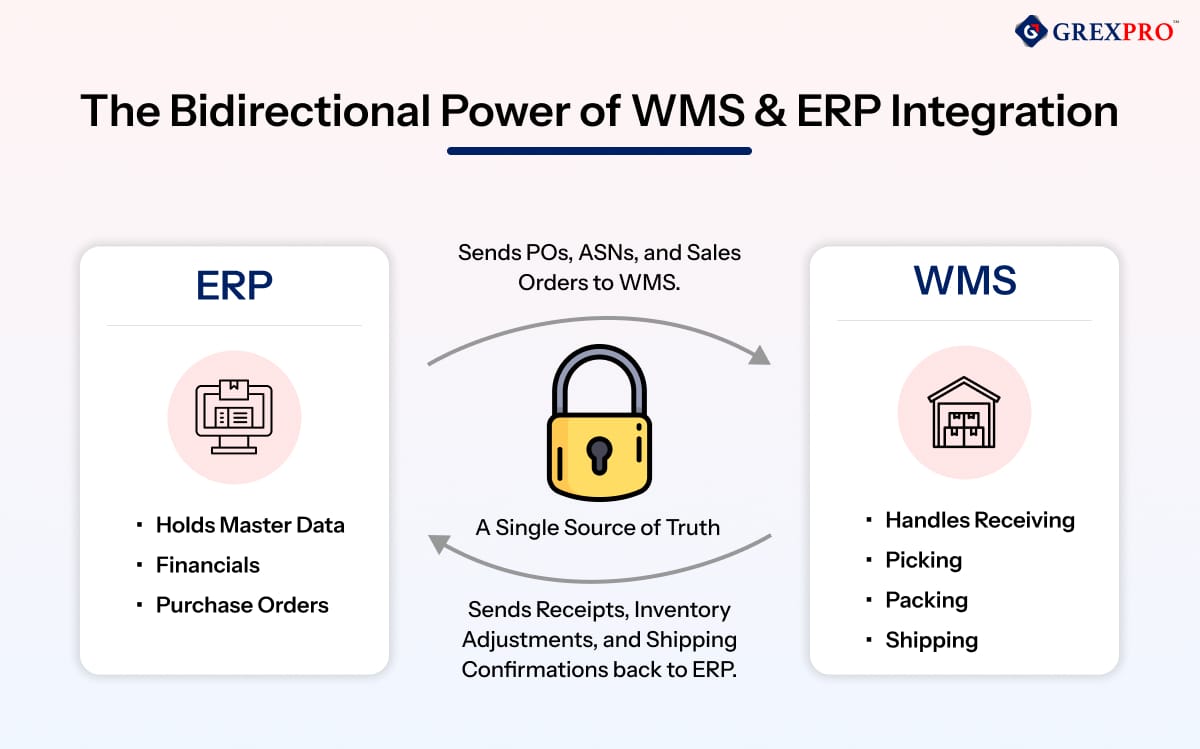
When the ERP acts as the master record and the WMS acts as the execution engine, they constantly validate each other. If a unit is flagged as damaged during a quality check in the WMS, the ERP immediately removes it from available-to-sell inventory across all your digital channels, including your B2B wholesale showrooms.
Accelerating Time-to-Invoice
In a fragmented setup, finance cannot invoice a wholesale client until the warehouse manually confirms shipment. With GrexPro facilitating a unified view, the moment the WMS scans the carrier label at the dock door, the ERP automatically generates and emails the invoice. Cash flow accelerates by days.
Precision in Demand Planning
You cannot forecast what you cannot see. When ERP inventory management is fed by real-time WMS data, your merchandising teams can confidently plan reorders based on actual sell-through velocity, rather than last week’s stale reports.
The Next Step Forward
Relying on fragmented software to manage millions of dollars in inventory is a risk you no longer have to take. The primary benefit of connecting these platforms is absolute operational certainty. When your financial system and your physical warehouse operate from the exact same dataset, you stop managing chaos and start managing growth. Audit your current data flow today. If your teams are exporting CSVs just to understand what you own, you need an integrated ecosystem.
If your operations team is spending hours manually reconciling inventory between your warehouse and your accounting software, you are losing money on every order.
Explore GrexPro’s WMS module to automatically sync your floor operations with your financial data and connect your supply chain ecosystem today.
Ready to stop bridging system gaps with spreadsheets? Let’s connect your ecosystem.
Ready to transform your business operations?
Discover how our comprehensive solutions can streamline your workflows, boost productivity, and drive sustainable growth.
FAQ
Q: What are the primary benefits of WMS integration with ERP?
A: Integration eliminates manual data entry, prevents overselling across channels, and ensures your financial reporting matches your physical inventory in real-time. It accelerates order fulfillment and reduces the administrative burden on your operations team.
Q: How does WMS ERP integration impact warehouse automation?
A: Physical automation requires instantaneous data to function. An integrated ERP feeds the WMS the live order data needed to direct automated conveyors, robotics, and optimized pick-paths effectively.
Q: Why is my ERP inventory management always inaccurate without integration?
A: Without an automated connection, your ERP only knows what was true the last time someone manually updated it. Every return, damaged item, or picked order that happens between those manual updates creates a dangerous blind spot called inventory distortion.
Q: What are standard WMS ERP integration best practices?
A: The most critical practice is establishing a single source of truth by defining clear system roles for specific data points. The ERP typically owns financial data and item masters, while the WMS owns bin locations and physical counts.

 Surendra Yarrum