
 5th March 2026
How Multi Location Warehouse Management Improves Supply Chain Control
Summary
As supply chains expand and delivery expectations increase, many businesses now operate more than one warehouse to support regional demand. While this improves distribution speed, it also introduces new operational challenges. Without proper coordination, managing inventory across multiple facilities can lead to stock discrepancies, inefficient fulfilment, and limited visibility.
Multi location warehouse management helps organisations maintain control over distributed warehouse networks by providing centralised visibility into inventory, stock movement, and order fulfilment. Instead of managing each warehouse separately, businesses can coordinate operations through a unified system.
With the support of multi location inventory management software, companies gain real-time insights into inventory levels, automate stock allocation, and maintain stronger warehouse inventory control across locations. This approach enables businesses to optimise logistics operations, improve order fulfilment, and build a more responsive supply chain.
The Growing Complexity of Multi-Warehouse Operations
Modern supply chains are increasingly decentralised. Manufacturers, distributors, and e-commerce companies often operate multiple warehouse locations to reduce delivery times and serve regional markets more effectively.
However, managing inventory across different facilities can become complex when systems are disconnected. Many organisations still rely on spreadsheets or separate tools to track stock across warehouses. This fragmented approach makes it difficult to maintain accurate inventory records and coordinate fulfilment efficiently.
Without a structured approach to multi location inventory management, warehouses may operate independently rather than as part of an integrated logistics network. This can result in:
- Inventory imbalances between locations
- Delayed order fulfilment
- Inefficient stock transfers
- Limited supply chain visibility
A centralised warehouse system helps resolve these challenges by synchronising inventory data and operational workflows across all locations.
Streamline Operations & Drive Smarter Growth
Looking to optimize workflows, reduce inefficiencies, and scale faster? Discover how GrexPro’s intelligent solutions can transform the way your business works.
What Is Multi Location Warehouse Management?
Multi location warehouse management refers to the process of managing inventory, stock movement, and fulfilment across several warehouse locations through a single centralised platform.
Rather than treating each warehouse as an isolated unit, businesses can coordinate operations and maintain consistent inventory data across the entire network.
A structured multi-warehouse system allows organisations to:
- Monitor stock levels across locations
- Manage inventory transfers between warehouses
- Allocate orders based on proximity and availability
- Maintain consistent operational workflows
By integrating warehouse operations into one platform, businesses gain better control over distributed inventory and can respond faster to demand fluctuations.
Key Benefits of Multi Location Inventory Management
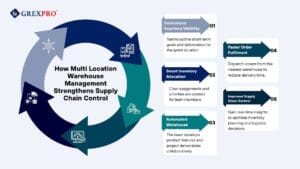
1. Centralised Inventory Visibility
One of the main advantages of multi location inventory management is improved visibility across all warehouse facilities. Managers can monitor stock levels, incoming shipments, and order fulfilment from a single dashboard.
This eliminates the need for manual reporting and helps maintain accurate inventory records across locations.
2. Faster Order Fulfilment
When inventory is distributed across multiple warehouses, businesses can fulfil orders from the location closest to the customer. This reduces shipping times and improves delivery performance.
Location-based fulfilment also lowers transportation costs and enhances overall supply chain efficiency.
3. Balanced Inventory Distribution
Without centralised control, one warehouse may experience stock shortages while another holds excess inventory.
A structured warehouse system helps maintain balanced inventory levels by enabling automated allocation and replenishment rules. This strengthens warehouse inventory control and ensures consistent product availability across facilities.
4. Efficient Stock Transfers
Businesses operating several warehouses frequently move products between locations to meet regional demand. A digital system records and tracks these transfers to maintain accurate inventory data.
Structured workflows also ensure that stock movement between warehouses remains visible and traceable.
5. Improved Supply Chain Decision-Making
When inventory data from all locations is consolidated, businesses gain deeper insights into demand trends and warehouse performance.
Supply chain managers can analyse stock movement patterns, identify inefficiencies, and optimise inventory placement to support operational growth.
Businesses that implement structured warehouse systems often rely on advanced warehouse management system features to improve inventory tracking, stock accuracy, and operational efficiency across facilities.
How Multi Location Warehouse Management Improves Operations
The benefits of coordinated warehouse operations become clearer when comparing traditional setups with centralised inventory management.
| Operational Area | Traditional Warehouse Setup | Multi Location Warehouse Management |
| Inventory Visibility | Limited to individual warehouses | Real-time view across all locations |
| Order Fulfilment | Centralised dispatch | Location-based fulfilment |
| Stock Allocation | Manual planning | Automated allocation rules |
| Inventory Accuracy | Higher risk of discrepancies | Unified inventory records |
| Demand Response | Slower adjustments | Faster regional stock allocation |
A coordinated system transforms individual warehouses into a connected logistics network that improves supply chain control.
Challenges Businesses Face with Multiple Warehouses
While operating multiple warehouses improves distribution capabilities, it also creates operational complexity if not managed properly.
Inventory Synchronisation
Without real-time updates, inventory records across warehouses can quickly become inconsistent.
Order Routing Decisions
Determining which warehouse should fulfil each order can be difficult without automated allocation rules.
Stock Imbalance
Some locations may run out of stock while others carry excess inventory.
Limited Visibility
Disconnected systems make it difficult for supply chain managers to monitor inventory movement and warehouse performance.
These challenges highlight the need for structured multi location inventory management software that centralises warehouse operations and synchronises inventory data across facilities.
Many organisations address this issue by implementing a real-time warehouse tracking system, which provides instant visibility into inventory movement and helps maintain accurate stock data across warehouse locations.
Features to Look for in Multi Location Inventory Management Software
Businesses implementing a multi-warehouse strategy should choose technology that provides strong operational visibility and automation capabilities.
Important features include:
- Centralised inventory dashboard
- Real-time inventory tracking across warehouses
- Automated replenishment and allocation rules
- Inter-warehouse transfer management
- Location-based order routing
- Inventory analytics and reporting
When integrated with procurement and supplier management platforms, these capabilities create a connected supply chain ecosystem that improves operational efficiency.
For example, modern warehouse systems often work alongside advanced warehouse management system features to streamline inventory tracking and warehouse workflows.
Organisations exploring warehouse technology adoption can also refer to this warehouse management system guide to understand key selection criteria.
How Grexpro Supports Multi Location Warehouse Management
As supply chains grow, warehouse operations must evolve from isolated facilities into coordinated distribution networks.
Grexpro provides an integrated platform designed to help businesses manage distributed inventory efficiently. The platform enables organisations to coordinate warehouse operations, monitor inventory across locations, and maintain accurate stock records.
With Grexpro, businesses can:
- Track inventory across multiple warehouse locations
- Automate stock allocation and replenishment
- Manage inter-warehouse transfers efficiently
- Improve warehouse visibility with real-time data
- Connect warehouse operations with procurement and supplier management
By integrating warehouse operations into a unified platform, Grexpro helps organisations maintain stronger supply chain control while supporting scalable growth.
Ready to transform your business operations?
Discover how our comprehensive solutions can streamline your workflows, boost productivity, and drive sustainable growth.
Conclusion
As supply chains expand, managing inventory across multiple facilities becomes increasingly complex. Businesses that rely on disconnected systems often struggle with limited visibility, stock discrepancies, and inefficient fulfilment processes.
Multi location warehouse management provides a structured approach to coordinate warehouse operations and maintain accurate inventory data across distributed networks.
By implementing modern multi location inventory management software, organisations can improve inventory visibility, optimise order fulfilment, and strengthen supply chain control. This approach enables businesses to manage growing warehouse networks efficiently while maintaining operational agility.
FAQs
Q: What is multi location warehouse management?
A: Multi location warehouse management is the process of managing inventory, stock movement, and warehouse operations across multiple facilities using a centralised system.
Q: Why do businesses need multi location inventory management?
A: Businesses use multi location inventory management to maintain accurate stock visibility, improve order fulfilment speed, and coordinate inventory across distributed warehouse networks.
Q: How does multi location inventory management software help supply chains?
A: The software synchronises inventory data across warehouses, automates stock allocation, tracks transfers between locations, and provides real-time operational insights.
Q: What are the challenges of managing multiple warehouses?
A: Common challenges include inventory inconsistencies, inefficient stock transfers, lack of visibility across locations, and complex order routing decisions.
Q: Can multi warehouse management improve delivery speed?
A: Yes. When inventory is distributed across multiple warehouses, businesses can ship products from the nearest location, reducing delivery times and logistics costs.


 Surendra Yarrum