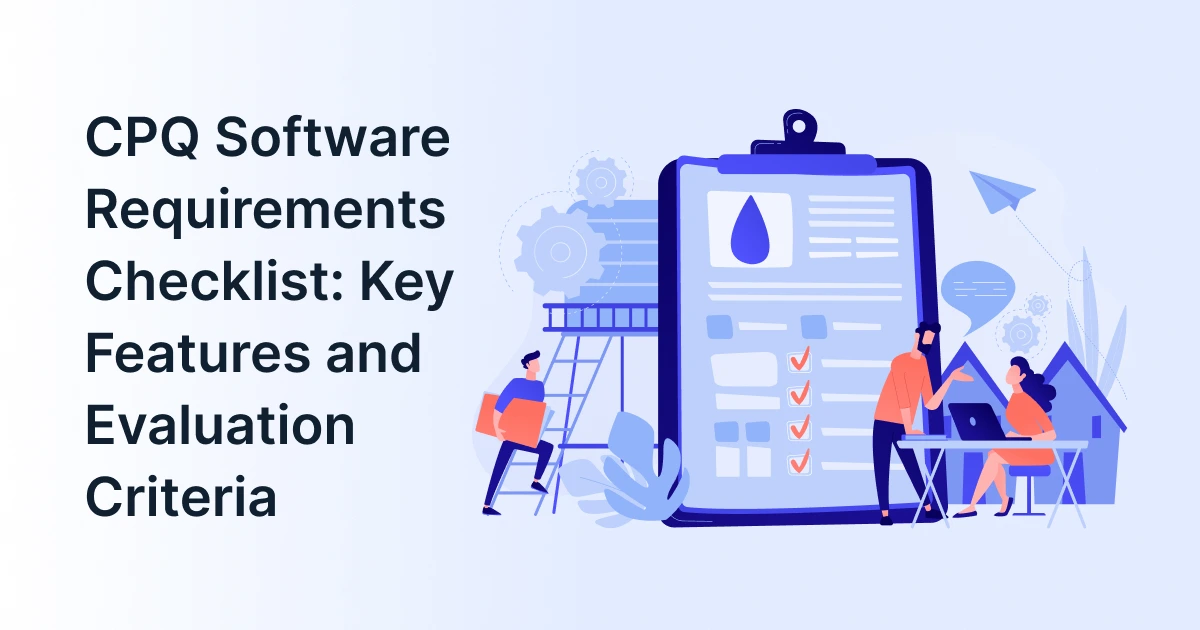
CPQ Software Requirements Checklist: Key Features and Evaluation Criteria

Choosing configure price quote software involves more than comparing features or booking product demonstrations. Your CPQ platform must handle your product configurations, pricing policies, approval workflows, and existing business systems.
A solution that works for simple product catalogs may struggle with complex manufacturing configurations. Similarly, a feature-rich platform may require more customization than your team can maintain.
That is why documenting your CPQ software requirements before comparing vendors matters. It gives your team a clear basis for evaluating capabilities, identifying gaps, and estimating implementation costs.
This CPQ software requirements checklist covers the essential features, manufacturing considerations, integration needs, and vendor evaluation criteria to review before making a purchase.

What should you evaluate before buying CPQ software?
Before buying CPQ software, evaluate product configuration, pricing rules, discount approvals, quote generation, integrations, security, scalability, implementation costs, and vendor support. Prioritize requirements according to your product complexity, sales process, and existing technology stack.
What Is CPQ Software Used For?
Configure, price, quote (CPQ) software helps businesses configure products or services, calculate accurate prices, and generate sales quotes based on predefined rules.
For B2B companies, CPQ software becomes particularly useful when product combinations, pricing agreements, or approval requirements make manual quoting difficult.
Consider a manufacturer selling industrial equipment with multiple specifications and optional components. Sales representatives must select compatible components, calculate prices, and prepare accurate quotations. CPQ software applies predefined rules to support these activities.
Your business may need CPQ when:
- Sales representatives repeatedly correct quotes.
- Pricing exceptions require frequent manual approvals.
- Product configurations involve complex dependencies.
- Teams rely on spreadsheets to calculate prices.
- Sales and operations use disconnected products or pricing data.
If these challenges affect your quoting process, a structured CPQ buying guide can help you identify which capabilities deserve priority.
Which CPQ Software Requirements Should You Evaluate Before Buying?
Use the following CPQ requirements checklist to assess whether a platform supports your current operations and future needs.
Product Configuration and Guided Selling
Start by evaluating how the software handles product combinations and configuration rules.
Check whether it can:
- Enforce product dependencies and compatibility restrictions.
- Support bundles, optional components, and product variants.
- Prevent invalid configurations before generating quotes.
- Guide sales representatives through product selection.
- Allow authorized users to update rules without extensive development.
Ask vendors to demonstrate a complicated configuration rather than standard product selection. This reveals whether the platform can handle your actual selling process.
Pricing Rules, Discounts, and Approvals
Pricing capabilities determine whether your team can create accurate, commercially viable quotes.
Your CPQ features checklist should include:
- Tiered, volume-based, contract, and regional pricing.
- Customer-specific price lists and negotiated rates.
- Discount limits and margin protection rules.
- Approval workflows for non-standard pricing.
- Records of pricing changes and approval decisions.
Ask the vendor to demonstrate a quote that exceeds your discount threshold. Check whether the system routes it to the correct approver and records the decision.
Quote Generation and Document Management
Generating a quote should not require extensive manual corrections after configuration and pricing are complete.
Evaluate whether the platform supports branded templates, accurate line items, standard terms, quote revisions, and version control.
Also, check whether approved quotes can pass relevant information into contract management and order processing systems.
Why it matters? Because consistent quote documents reduce avoidable errors and help sales teams maintain control over customer-facing proposals.
CRM, ERP, and Business System Integration
Integration deserves particular attention when your business already uses CRM, ERP, finance, or inventory management software.
Verify whether the CPQ platform can exchange relevant customer, product, pricing, and order data with these systems.
Ask vendors about:
- Available connectors and APIs.
- Data synchronization frequency and error handling.
- Ownership of product and pricing records.
- Integration implementation and maintenance costs.
- Monitoring and recovery when data transfers fail.
Do not accept a general promise of integration compatibility. Request a demonstration using your intended systems or a technically representative test environment.
Usability, Security, and Scalability
A CPQ solution must remain manageable after implementation.
Check whether business users can maintain rules; sales representatives can learn the interface quickly, and administrators can test changes before deployment.
Review role-based access, audit logs, data protection, and backup arrangements. The National Institute of Standards and Technology (NIST) provides guidance on evaluating software security practices during procurement.
Finally, assess whether the system can accommodate new products, users, regions, and pricing models without requiring a major redesign.
What Additional CPQ Requirements Matter for Manufacturing?
Manufacturers often need more than standard product configuration and pricing capabilities. Their CPQ requirements for manufacturing may involve engineering rules, component dependencies, and downstream production processes.
Evaluate these capabilities according to your product and manufacturing model.
- Engineering constraints: Can the system validate technical specifications and component compatibility?
- Bill of materials (BOM): Can it generate accurate component lists from configured products when required?
- Product variants: Can it support configurable dimensions, materials, options, and specifications?
- ERP integration: Can approved configurations and order details reach relevant downstream systems?
- Engineering changes: Can updated product rules be managed without creating inconsistencies in active quotes?
- Visual configuration: Would CAD or 3D visualization help users validate complex products?
For example, a manufacturer offering customized industrial equipment may need configuration rules that prevent incompatible motor, capacity, and component selections.
What should manufacturers look for in CPQ software?
Manufacturers should prioritize engineering-rule validation, product variant management, configurable BOM generation, pricing controls, and ERP integration. Businesses selling highly engineered products should also verify support for their technical constraints and engineering workflows.
The right requirements depend on whether your business assembles standard options, configures products to order, or engineers products for individual customers.
How Should You Compare CPQ Vendors Before Making a Decision?
Once you have documented your CPQ software requirements, evaluate vendors using identical scenarios rather than relying on presentations alone.
Test Your Actual Quoting Process
Ask every shortlisted vendor to demonstrate three scenarios:
- Configure a product with multiple dependencies and exclusions.
- Apply a discount that requires management approval.
- Generate a quote and transfer approved information into your existing business systems.
- Record whether each scenario works natively, requires customization, or depends on another application.
Use a Weighted Evaluation Scorecard
A simple scoring model helps your team compare CPQ features against business priorities.
Here is the information organized into a table:
| Evaluation criterion | Suggested weight |
| Product configuration | 25% |
| Pricing and approval controls | 25% |
| Integrations and data transfer | 20% |
| Usability and administration | 15% |
| Implementation, support, and cost | 15% |
These weights are starting points, not universal benchmarks. Adjust them to reflect your industry and operational needs.
Gartner’s Critical Capabilities for Configure, Price and Quote Applications evaluates CPQ applications across multiple use cases and capabilities. Its research reinforces the value of assessing software against specific business scenarios rather than relying solely on overall vendor positioning.
Also, request a complete cost breakdown covering licensing, implementation, customization, integration, training, support, and ongoing administration.

How do you compare CPQ software vendors?
Define mandatory requirements, score vendors against weighted criteria, and test each platform using identical quoting scenarios. Compare integration depth, implementation effort, total cost of ownership, support, and the ability to maintain configuration and pricing rules after deployment.
What CPQ Implementation Mistakes Should You Avoid?
Even a suitable platform can disappoint when requirements and implementation decisions are poorly managed.
Automating Unclear Business Rules
Configuring software before documenting product dependencies, pricing policies, and approval limits can reproduce existing inconsistencies. Validate business rules before implementation.
Over-Customizing the Platform
Custom development can increase costs and make future upgrades harder. Check whether native CPQ features can meet the requirements before commissioning custom code.
Ignoring Integrations and User Needs
A quote may be correct in CPQ but still contain incomplete information when transferred to an ERP or order management system. Involve Sales, Finance, IT, and Operations early, and test the complete workflow.
Conclusion
The right CPQ solution should support your quoting process, accommodate product complexity, and work with your existing business systems. A clear requirements checklist helps your team evaluate vendors based on practical capabilities rather than feature counts alone.
GrexPro offers cloud solutions across B2B, ERP, WMS, and CPQ to support businesses in meeting their technology and operational needs. As you evaluate your options, define your priorities, test real-world quoting scenarios, and assess the long-term effort required to maintain the system.
FAQs
Q: What are the most important CPQ software requirements?
A: The core requirements include product configuration, pricing rules, discount approvals, quote generation, integrations, security, and scalability. Prioritize them based on your products and sales processes.
Q: What should a CPQ requirements checklist include?
A: Include functional features, integration needs, user roles, security controls, implementation requirements, vendor support, and total cost. Classify each requirement as must-have, should-have, or optional.
Q: Which CPQ features are essential for manufacturing?
A: Manufacturers may need engineering constraints, product variants, BOM generation, and ERP integration. Highly configurable products may also require visual configuration and advanced rule management.
Q: How do I know if CPQ software is right for my business?
A: Test whether the platform can handle your real product configurations, pricing exceptions, approval workflows, and downstream data transfers. Compare the results against documented requirements.
Q: How much does CPQ software cost?
A: Costs depend on licensing, user numbers, product complexity, implementation, customization, integrations, and support. Request a complete cost estimate before comparing vendor proposals.
Author
Managing Director of Grexpro
Surendra Yarrum is a Business Strategist at GrexPro with expertise in ERP, CRM, and warehouse management systems, helping businesses enhance efficiency and optimize supply chain operations.
Latest Blogs