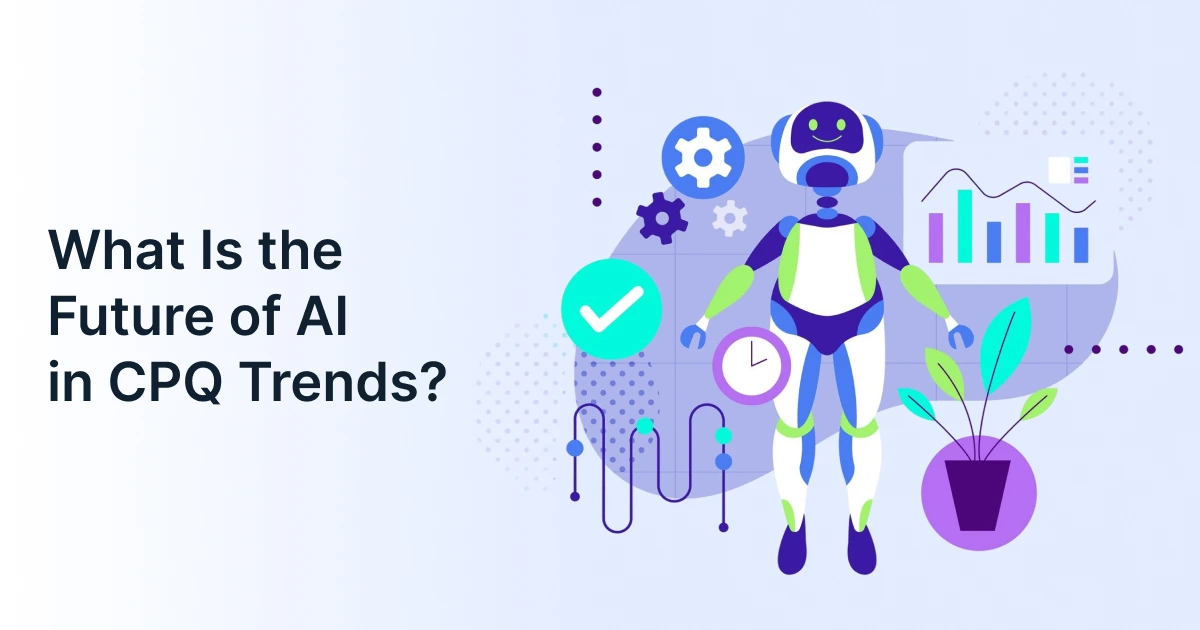
What Is the Future of AI in CPQ Trends?

According to Vantage Point, companies using CPQ solutions can reduce quote cycle times by 30–50%, highlighting just how slow and inefficient manual quoting processes can be.
Sales teams today are under constant pressure to move faster. But quoting is still one of the biggest slowdowns. Pricing approvals take time. Configurations get messy. And small errors turn into big problems.
This is exactly where the future of AI in Configure Price Quote software comes into play.
Simply put, AI is turning CPQ into a smarter system that not only speeds up quoting but also helps teams make better pricing decisions using real data.
Instead of relying on manual inputs and fixed rules, AI brings flexibility, accuracy, and speed.
In this blog, we’ll learn:
- Why Does the Future of AI in Configure Price Quote Software Matter?
- How Will AI-Powered CPQ Change How Sales Teams Work?
- What are the Benefits of AI in CPQ trends?
- How Does Intelligent Sales Automation Fit Into CPQ?
- What Does the Future of AI-powered CPQ Software Look Like?
- AI CPQ Implementation Strategy
- What Happens If You Don’t Adopt AI-enabled CPQ?
Why Does the Future of AI in CPQ Trends Matter?
Let’s take a step back.
Traditional CPQ systems rely on predefined business rules. While effective for standardized products, they struggle with dynamic pricing, complex product catalogs, and changing customer expectations. AI enhances these systems by learning from historical data instead of relying solely on fixed logic.
For example, a sales rep spends hours preparing a quote:
- Checks pricing sheets
- Gets approvals from finance
- Adjusts configurations
By the time the quote is ready, the customer has already moved on. That delay is expensive. This is why AI-enabled CPQ is becoming essential, not optional.
It removes friction, speeds things up, and reduces mistakes.

How Will AI-Powered CPQ Change How Sales Teams Work?
At its core, AI-powered CPQ is about making decisions easier and faster. It doesn’t replace sales teams. It supports them. So, what changes in day-to-day work?
Product Configuration Becomes Easier
Instead of manually selecting combinations, AI suggests options.
It looks at:
- Previous deals
- Customer behavior
- What usually works
This saves time and reduces confusion.
Pricing Becomes Smarter
This is where pricing AI really stands out. It evaluates:
- Demand trends: Analyzes market demand patterns to adjust pricing based on rising or falling interest.
- Customer purchase history: Uses past buying behavior to personalize pricing and offers for each customer.
- Competitor pricing: Monitors competitor rates to keep pricing competitive and strategically positioned.
- Inventory availability: Adjusts pricing based on stock levels to prevent shortages or excess inventory.
- Profit margin targets: Ensures pricing aligns with predefined profitability goals.
- Win probability: Predicts the likelihood of closing a deal and optimizes pricing to improve success rates.
AI adjusts quotes based on customer value, market demand, and historical trends. This means better pricing decisions without endless back-and-forth.
Quote Creation Becomes Faster
What used to take hours can now take minutes. Sales reps don’t need to:
- Manually calculate pricing
- Double-check every detail
- Wait for approvals endlessly
Everything moves faster.
Sales Teams Get Clearer Insights
AI-enabled CPQ doesn’t just create quotes, it tells you:
- Which deals are likely to close?
- Where margins are weak?
- Which customers need attention?
This helps teams focus on what matters.
Learn more about the role of AI in advanced CPQ solutions for smart pricing.
What Are the Benefits of AI in CPQ Trends?
Let’s break this down in a detailed way.
Quick Comparison
| Feature | Traditional CPQ | AI-powered CPQ |
| Quote generation | Manual | AI-assisted |
| Pricing | Rule-based | Predictive |
| Recommendations | None | AI suggestions |
| Upselling | Manual | Automated |
| Forecasting | Limited | Predictive Analytics |
Key Benefits
Faster sales cycles
The biggest change is speed. Quotes go out quicker, which means deals move faster.
Better pricing decisions
With predictive pricing in CPQ, decisions aren’t based on guesswork anymore.
Fewer errors
Manual errors drop significantly because AI handles calculations and logic.
Stronger customer trust
Customers receive accurate quotes quickly. That builds confidence.
Scalable operations
As businesses grow, AI-enabled CPQ scales without adding complexity.
How Does Intelligent Sales Automation Fit Into CPQ?
You’ll hear a lot about intelligent sales automation. But what does it really mean in this context? It simply means using AI to handle repetitive work and support decision-making.
Where It Helps Most?
1. From lead to quote
AI helps answer:
- What should we sell?
- What price makes sense?
- How likely is this deal to succeed?
2. Approval workflows
Approvals are often a bottleneck. AI solves this by:
- Automatically routing requests
- Flagging risky deals
- Reducing unnecessary approvals
3. System integration
AI-enabled CPQ connects with:
- CRM systems for customer data
- ERP systems for financial accuracy
This keeps everything aligned.
What Does the Future of AI-powered CPQ Software Look Like?
Let’s look ahead, with some realistic expectations and benchmarks for AI in CPQ.
What’s Already Changing?
AI-generated quotes
Quotes will be created automatically, based on customer needs and past data. No more starting from scratch.
Real-time pricing
Prices will adjust instantly. For example:
- High-demand products will have optimized pricing.
- Returning customers will have personalized pricing.
Less manual work
Sales reps will spend less time on admin tasks and more time on selling.
Personalized experiences
Every quote will feel customized to client requirements. Not just in pricing, but also in:
- Product bundles
- Recommendations
- Communication
So, the future of AI-powered CPQ software is not about replacing humans. It’s about, removing repetitive work, improving decisions, and reducing delays.

AI CPQ Implementation Strategy
Adopting CPQ automation software with AI takes planning. It’s not just about installing a tool. Here’s a simple way to approach it:
Step 1: Identify current gaps
Look at where things are going wrong:
- Slow approvals
- Pricing mistakes
- Configuration errors
Step 2: Define clear goals
What do you want to improve?
- Speed
- Accuracy
- Deal size
Step 3: Choose the right solution
Look for:
- Integration with ERP and CRM
- Support for compliance (RBAC, GDPR)
- Flexibility for your workflows
Step 4: Use your existing data
AI works best when it learns from past deals. Clean, structured data makes a big difference.
Step 5: Start small and scale
You don’t need to transform everything at once. Start with one process, then expand.
There are also some important trade-offs to consider. For example, setup takes time, teams need training, and data quality matters. But once things are in place, the benefits are clear.
What Happens If You Don’t Adopt AI-enabled CPQ?
This is something many teams ignore. Let’s see the cost of inaction.
- Slow quotes mean lost deals.
- Incorrect pricing means lower margins.
- Manual work means frustrated teams.
- Poor customer experience
Over time, these issues affect growth. Companies that use AI-powered CPQ move faster. And that gap keeps growing.
| Without AI | With AI |
| Longer sales cycles | Faster responses |
| Higher operational costs | Better pricing |
| Lower forecasting accuracy | Improved customer satisfaction |
| More pricing inconsistencies | Greater sales efficiency |
Key Takeaways:
AI is shifting CPQ from reactive to predictive
- Speed is becoming a competitive advantage
- Pricing decisions are becoming smarter, not harder
- Intelligent sales automation reduces manual work
- Accuracy and consistency improve significantly
- The future is more personalized and adaptive
- Implementation requires planning, not just tools
- Ignoring AI in CPQ comes with real risks
Conclusion
The future of AI in Configure Price Quote software is all about making sales processes simpler and smarter. As product complexity and customer expectations continue to rise, AI-powered CPQ will evolve from a competitive advantage into a business necessity. Organizations that invest early will be better positioned to deliver faster quotes, improve pricing precision, and build more scalable sales operations. Most importantly, it helps sales teams focus on selling, not struggling with systems.
If you’re looking to move in that direction, solutions like GrexPro are built to make that transition smoother, more practical, and scalable.
FAQs
Q: How does AI improve CPQ accuracy?
A: AI improves accuracy by using past data and patterns instead of manual inputs. It reduces pricing errors and ensures consistent configurations, making quotes more reliable.
Q: What is predictive pricing in CPQ?
A: Predictive pricing uses AI to suggest the best possible price based on trends, customer data, and previous deals. It helps balance competitiveness and profitability.
Q: What are the benefits of AI in CPQ systems?
A: AI in CPQ offers faster quote generation, better pricing decisions, reduced errors, improved customer experience, and more efficient sales processes.
Q: How can businesses start using AI-powered CPQ?
A: Start by identifying gaps in your current process, selecting the right CPQ automation software, and using your data to train the system. Then improve gradually.
Q: What is the future of AI-powered CPQ software?
A: The future includes automated quoting, real-time pricing, smarter decision-making, and personalized customer interactions powered by AI.
Author
Managing Director of Grexpro
Surendra Yarrum is a Business Strategist at GrexPro with expertise in ERP, CRM, and warehouse management systems, helping businesses enhance efficiency and optimize supply chain operations.