
 31st March 2026
How to Capitalize on 2026 Warehouse Automation Trends Without Breaking Your Supply Chain
Summary
You cannot fix a fundamentally broken supply chain simply by adding robots to your distribution center. This breakdown explores the reality behind current warehouse automation trends and why rigid, heavy-metal systems are being outpaced by flexible, data-first infrastructure. You will walk away with a clear framework for evaluating the types of warehouse automation your brand actually needs, and why cleaning up your inbound WIP is a mandatory prerequisite to any robotics investment.
Your distribution center just received 10,000 units of your core fall jacket. The problem? The packing list is a mess, the barcodes don’t match the master data, and your receiving team is manually recounting boxes while wholesale orders pile up.
When facing this chaos, brands frequently look to warehouse automation as a silver bullet. You watch a glossy demo of an autonomous mobile robot gliding across a facility and assume it will magically resolve your fulfillment delays. It won’t.
Automating a chaotic process just gives you faster chaos. If your inbound data from global vendors is inaccurate, the most advanced robotic picking system in the world will just pick the wrong item with terrifying efficiency.
Here are the specific warehouse automation trends actually moving the needle for apparel brands in 2026, and how to align your physical automation strategy with your upstream supply chain data.
Trend 1: The Death of Rigid Infrastructure and the Rise of AMRs
For years, the gold standard of warehouse automation technology was the Automated Storage and Retrieval System (AS/RS). These massive, bolted-down steel grids and conveyor belts promised incredible density. But the apparel industry is seasonal, volatile, and prone to sudden shifts in SKU velocity.
When you build a permanent physical structure based on today’s order profiles, you trap your operations in amber. If consumer demand shifts, your multi-million dollar AS/RS cannot easily adapt to the new pick paths. We are seeing a massive market correction away from inflexible infrastructure toward adaptable, modular robotics.
Streamline Operations & Drive Smarter Growth
Looking to optimize workflows, reduce inefficiencies, and scale faster? Discover how GrexPro’s intelligent solutions can transform the way your business works.
The Operational Autopsy: The Rigid Grid Pullback
In late 2025, grocery giant Kroger acknowledged that its massive bet on rigid robotic fulfillment centers had gone too far, resulting in the closure of three automated facilities and a multi-billion dollar course correction. The failure point was volume density. The massive fixed costs of the centralized warehouse automation systems required relentless, predictable order volume to break even. When consumer habits shifted, the bolted-down technology became a financial anchor. For apparel brands, the lesson is identical: over-committing to rigid physical automation before stabilizing your variable volume is a fast track to margin erosion.
This brings us to the actual financial drag operators face daily when evaluating automation ROI.
The Cost of Inaction: Why Status Quo Fails
- The average distribution center loses nearly half a million dollars ($400,000) annually to mispicks, meaning minor barcode errors originating at the vendor level are quietly destroying your net margin by the time goods reach the packer. ( Honeywell Distribution Center Analysis)
- The hard cost of rectifying a single mispick in labor is $30 – $75 per error, returns, and reshipping, proving that poor accuracy is vastly more expensive than slow picking. (VOCADS Logistics Report)
Trend 2: Software Preceding Hardware
You cannot adopt warehouse automation systems if your product data is siloed.
A robot needs clean data to function. If your tech packs, Bill of Materials (BOM), and initial POs live in spreadsheets, and your warehouse runs on a disconnected local server, the data gap will cripple your fulfillment. Your warehouse team will spend hours manually verifying incoming shipments because they do not trust the Advanced Shipping Notices (ASNs) generated by your vendors.
When evaluating essential warehouse inventory software features, seamless integration with your upstream manufacturing data is non-negotiable. While managing your upstream manufacturing, your Supply chain and WIP tracking data should flow seamlessly. The warehouse knows exactly what is on the water, exactly how it is packed and exactly when it will hit the dock door.
Did you know? |
| A massive 57% of supply chain leaders cite technological barriers to data exchange and misaligned goals as the top two challenges paralyzing effective partner collaboration. Your biggest vendor bottleneck is ofter the disconnected software and spreadsheets standing between your data and their production floor. Source: GS1 (Report: Powering Supply Chain Confidence March, 2025 ) |
Trend 3: Wearables as the First Step to ROI
Before investing in autonomous fleets, leading brands are capturing immediate ROI through wearable tech. Voice-directed picking and wearable ring-scanners are low-capital, high-impact types of warehouse automation.
These lightweight systems eliminate the need for workers to constantly look at paper lists or handheld screens. Voice systems guide the picker to the exact location, and a quick scan of the barcode verifies the item instantly. This physically prevents a mispick from occurring, attacking the core margin drain identified earlier without requiring a poured concrete foundation.
| Capability | Rigid Automation (AS/RS, Fixed Conveyors) | Flexible Automation (AMRs, Wearables) |
| Capital Expenditure | Massive upfront investment ($5M+). | Scalable, often available as Robotics-as-a-Service. |
| Implementation Time | 12 to 24 months. | 4 to 8 weeks. |
| Scalability | Fixed capacity. Cannot easily expand. | Highly adaptable. Add or remove robots as volume dictates. |
| Single Point of Failure | High. A jammed conveyor stops the entire zone. | Low. If one AMR fails, the fleet automatically reroutes. |
Trend 4: B2B/DTC Unified Automation Logic
B2B fulfillment requires an entirely different workflow than direct-to-consumer shipping. When a major retail partner drops a massive wholesale order, it is often negotiated using advanced CPQ tools to automate complex pricing and quotes. It is impossible for your warehouse to treat it like 500 individual e-commerce purchases.
Modern automation logic must understand inventory allocation priorities. If your B2B platform is fully integrated with your supply chain ecosystem, the moment a wholesale buyer finalizes their digital showroom order, your system instantly ring-fences that inventory. The WMS then triggers your automated routing systems to consolidate those specific SKUs for palletization, completely bypassing the single-unit packing stations.
| “[The] need for enterprise digital transformation is leading organizations to re-examine their entire supply chains, because they understand that they need to go through this re-examination to stay competitive for today and increase resilience for the long-term.” — Adrian Stoch, Chief Automation Officer, GXO Logistics |
Ready to transform your business operations?
Discover how our comprehensive solutions can streamline your workflows, boost productivity, and drive sustainable growth.
The Next Step
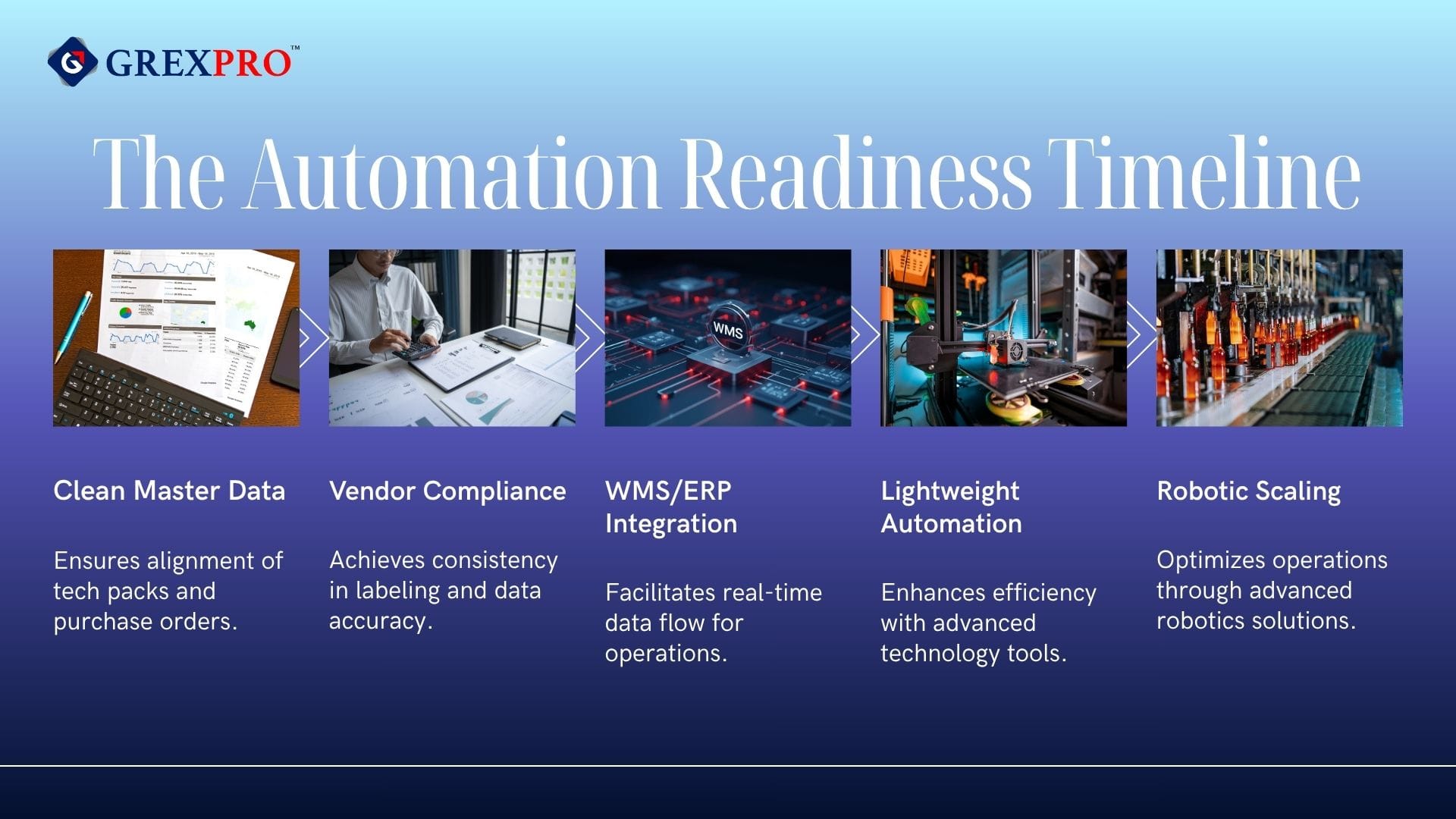
Treat physical warehouse automation as a magnifying glass. If your supply chain data is clean, automation will magnify your efficiency, drive down labor costs, and accelerate your time-to-market. If your vendor data is a mess, automation will simply magnify your errors, shipping the wrong products to the wrong customers at record speed.
Before you sign a contract for a fleet of robots, look at your inbound processes. Fix the data at the factory level, mandate strict compliance on your packing lists, and unify your systems. Clean data is the only foundation that supports true automation.
If your warehouse is flying blind because vendor packing lists don’t match reality, no amount of robotics will save your receiving dock. GrexPro digitizes the entire vendor compliance process so inbound shipments are 100% accurate before they ever leave the factory. Talk to us and know how GrexPro makes your Supply Chain interconnected.
FAQ (Frequently Asked Questions)
Q: What exactly is warehouse automation?
A: Warehouse automation is the deployment of software and physical technology to eliminate manual, error-prone tasks inside your distribution center. Instead of relying on clipboards and memory, it spans everything from basic wearable barcode scanners that verify inventory to advanced autonomous robots that physically move pallets of apparel.
Q: How do warehouse automation systems actually work?
A: The entire process is triggered by clean data flowing from your upstream supply chain directly into your Warehouse Management System (WMS). Once a wholesale or DTC order drops, the WMS acts as the brain, instantly calculating the most efficient pick path and sending digital commands to either your robotic fleet or your floor workers to retrieve and pack the items.
Q: What is the fastest way to see an ROI on warehouse automation?
A: Start with lightweight software automation and wearable tech. Implementing standard barcode compliance from your global vendors and utilizing wearable ring-scanners on the floor yields immediate accuracy improvements without multi-million dollar capital expenditures.
Q: Will Autonomous Mobile Robots (AMRs) replace my warehouse staff?
A: No. AMRs are designed to work alongside your staff, eliminating the non-value-added travel time (walking the aisles). This allows your team to focus exclusively on the actual picking and packing, drastically increasing their units-per-hour metric.
Q: How do I know if my warehouse is ready for physical robotics?
A: Your warehouse is ready when your inbound receiving operates flawlessly. If your team is still manually recounting boxes because vendor packing lists are untrustworthy, you must digitize your upstream supply chain and enforce vendor compliance before introducing robotics.

 Surendra Yarrum