
Summary
IoT warehouse automation is fundamentally changing how retail distribution operates. Instead of reacting to jammed sorters and lost pallets, supply chain leaders are using predictive analytics to fix bottlenecks before they disrupt fulfillment. This post breaks down the specific IoT based warehouse automation trends shaping 2026. You will learn how to integrate smart logistics into your operations to protect margins, ensure on-time delivery, and gain total visibility over your inventory.
The email drops into your inbox at 8:00 AM on Tuesday. Your flagship distribution center has a major backlog. A primary conveyor motor failed overnight. You have 15,000 units of a high-velocity seasonal collection sitting motionless on the floor. Wholesale orders will miss their shipping window. Retail stores will have empty displays this weekend.
You are now in damage control. You are paying expedited freight rates. You are drafting apologies to key accounts.
This is the reality of reactive supply chain management. If your operations run on historical data and visual inspections, you will always be one equipment failure away from a fulfillment crisis.
The most profitable retail brands have stopped playing catch-up. They are deploying IoT warehouse automation to turn passive storage facilities into intelligent, self-correcting networks. They know exactly when a machine will fail. They know the exact temperature and location of every pallet.
Here is how smart warehouse IoT is shifting the industry from damage control to proactive execution.
When a facility relies on visual inspections and rigid maintenance schedules, it operates with a massive operational blind spot. A piece of automated hardware might look fine on a Friday and catastrophically fail on a Monday.
As highlighted in a Supply Chain Dive report exploring the transition to smart distribution centers, relying on disconnected systems forces warehouses to constantly play defense against mechanical breakdowns. Traditional automation is blind to gradual wear and tear. If a motor belt on a primary outbound conveyor starts slipping, a legacy system won’t flag an error until the belt snaps entirely. This creates an immediate, severe bottleneck halting outbound volume and leaving the floor team scrambling to troubleshoot while delivery SLA clocks tick.
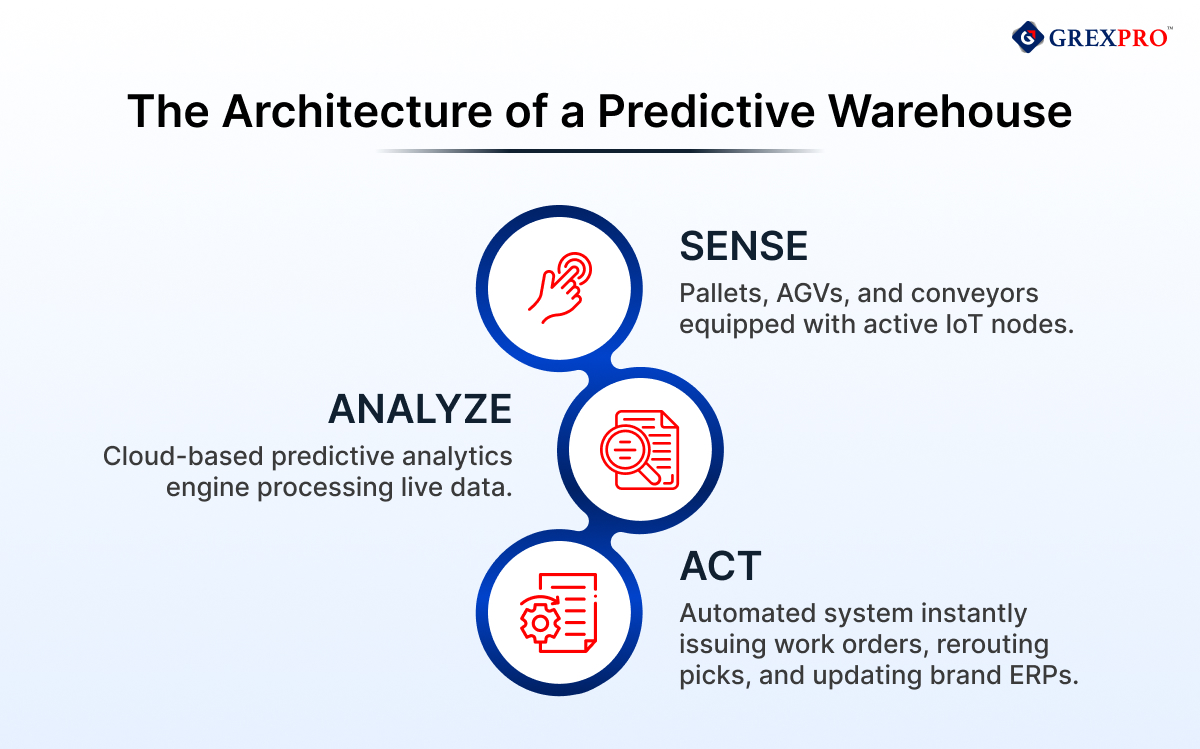
Instead of a sudden, peak-season breakdown, an IoT-enabled system detects that a specific motor is drawing slightly more power than its historical baseline. Cross-referencing this power anomaly with subtle temperature spikes and friction data, the predictive analytics engine flags the deteriorating belt weeks before it snaps. Within seconds, the system automatically triggers a work order and schedules the $50 belt replacement for a designated, off-hour maintenance shift.
The physical machinery remains the same, but the active integration of IoT data prevents a minor friction point from cascading into a multi-hour, highly expensive facility outage.
Looking to optimize workflows, reduce inefficiencies, and scale faster? Discover how GrexPro’s intelligent solutions can transform the way your business works.
Sticking to disconnected systems and reactive maintenance is an active choice to burn capital. Here is what happens when you ignore the shift toward smart logistics:
This means, every minute a scanner or conveyor is dead, your floor staff are standing still while your delivery SLA clocks keep ticking.
The definition of a modern facility is changing. It is no longer just about metal racks and forklifts. It is about deploying warehouse IoT solutions that generate actionable intelligence.
Basic RFID tags tell you an item passed through a dock door. That is table stakes. Modern smart warehouse IoT utilizes active sensors that provide continuous location, temperature, and humidity data. If you are shipping sensitive technical apparel or footwear with specific climate requirements, active sensors alert your quality assurance team if a container’s humidity spikes, preventing mold growth before the shipment reaches the retail floor.
The most immediate of the benefits of IoT in warehouse management is eliminating surprise breakdowns. IoT sensors continuously monitor the health of forklifts, automated guided vehicles (AGVs), and conveyor belts. They track heat signatures, vibration patterns, and energy consumption. When a motor draws 5% more power than its baseline, the system automatically triggers a work order before the component fails.
Customer demand fluctuates daily. Your warehouse layout should too. Predictive analytics engines ingest real-time sales data and physical inventory locations. The system then directs workers to move tomorrow’s high-volume SKUs to the front of the picking aisles today. This cuts picker travel time by hours and significantly accelerates outbound processing.
Most brands assume installing sensors makes their warehouse “smart.” In reality, data without an execution layer creates chaos. A dashboard showing 5,000 real-time sensor alerts is useless unless it is instantly translated into a prioritized action for the floor manager.
Source: Gartner Hype Cycle for Supply Chain Execution Technologies
You cannot run a 2026 supply chain on 2010 infrastructure. If your factory uses one system, your freight forwarder uses another, and your warehouse relies on manual spreadsheets, IoT data has nowhere to go.
| “[M]any companies struggle to scale IoT because they leave the data siloed… The value of IoT is only realized when it is fully integrated into the broader supply chain ecosystem, enabling end-to-end visibility.”
— Supply Chain Resilience Report, McKinsey & Company |
To actually capture value, your IoT hardware must feed directly into a unified ecosystem. When an IoT sensor flags a delayed inbound container, your system should automatically adjust warehouse labor schedules and update wholesale buyers, without requiring a single email. Understanding warehouse automation trends is only half the battle; integrating them is where the margin is won.
| Capability | Legacy Warehouse Operations | Smart Warehouse IoT |
| Inventory Tracking | Manual scans at fixed choke points. | Continuous, real-time spatial tracking. |
| Equipment Maintenance | Run-to-failure or rigid calendar schedules. | Predictive alerts based on actual machine wear. |
| Labor Allocation | Fixed daily schedules based on historical guesses. | Dynamic routing adjusting to live volume spikes. |
| Issue Resolution | Forensic. Investigating why an order was late. | Proactive. Rerouting workflows before the delay happens. |
You cannot fix what you cannot see. As consumer expectations for speed tighten and wholesale compliance rules become stricter, relying on manual warehouse processes is a massive operational risk.
IoT warehouse automation removes the blind spots. It stops the frantic morning emails. By deploying predictive analytics and connected sensors, you give your team the tools to manage exceptions before they become emergencies. The goal is not just to store boxes faster. It is to build a resilient, predictable fulfillment network that protects your brand’s reputation and bottom line.
If you are ready to stop fighting supply chain fires and start building a self-correcting fulfillment network, you need the right infrastructure. GrexPro’s warehouse management software connects directly with your IoT sensors, manufacturing partners, and retail channels to provide a single, actionable source of truth.
Contact us To map your transition to smart logistics today.
Discover how our comprehensive solutions can streamline your workflows, boost productivity, and drive sustainable growth.
Q: What is the first step to implementing IoT in my distribution center?
A: Start with your biggest bottleneck. Rather than outfitting the entire facility at once, apply IoT sensors to your most critical, high-risk equipment (like primary outbound sorters) to achieve an immediate ROI through reduced downtime.
Q: Does my brand need to own the warehouse to benefit from smart logistics?
A: No. Even if you use a 3PL, you should require them to provide real-time API access to their IoT data. This allows your internal team to see live inventory movements and predict fulfillment delays without waiting for weekly reports.
Q: How does predictive analytics actually lower my operating costs?
A: It eliminates the “buffer.” When you have exact, real-time data on inventory locations and equipment health, you no longer need to pay for excessive safety stock or staff overtime to compensate for unexpected delays.
Q: How do I integrate IoT sensors if my warehouse still runs on a legacy ERP?
A: You do not have to rip and replace your entire technical stack to start using smart data. Modern warehouse management software uses API middleware to translate raw sensor alerts into simple, actionable updates that your legacy ERP can easily process. The goal is bridging your data gap, not forcing a massive IT rebuild.
Q: Will my current floor team need complex training to use predictive analytics?
A: No. A properly integrated system does all the complex math in the background and issues simple, prioritized work orders directly to your staff’s handheld devices. The technology should adapt to your warehouse floor, not force your workers to become data scientists.
 7th April 2026

 Surendra Yarrum