Summary
Accurate sales forecasting is impossible when your quoting process is disconnected from your actual production costs. Relying on manual spreadsheets for B2B wholesale orders creates immediate margin erosion and severe supply chain delays. By integrating CPQ analytics into your operations, you align configured pricing with real-time manufacturing data. This structural shift transforms unpredictable pipeline guesswork into highly accurate, data-driven revenue forecasts.
Let’s take a hypothetical situation, which goes closer to reality. Your B2B sales team just closed a massive wholesale order for next season. The client customized the trim, requested a specific sustainable fabric, and demanded a bulk discount. The reps celebrate the closed-won deal in your CRM.
Then the order hits the sourcing department.
The fabric they promised has a 90-day lead time, not 30. The bulk discount they offered completely wipes out the margin on that specific SKU because the zipper costs have doubled since the spreadsheet was last updated. You now have a pipeline full of projected revenue that is entirely fictional.
This is the daily reality for brands running complex B2B wholesale operations without CPQ analytics. You cannot forecast revenue if the fundamental pricing and configuration data is broken at the point of sale. Here is how upgrading your sales reporting tools stops margin leakage and aligns your sales floor with your factory floor.
Looking to optimize workflows, reduce inefficiencies, and scale faster? Discover how GrexPro’s intelligent solutions can transform the way your business works.
When wholesale reps build quotes manually, they rely on outdated costing sheets. They guess on configurations to get the quote out the door quickly. This creates a massive ripple effect across your entire supply chain. If the data entering the top of your sales funnel is flawed, the forecast at the bottom is useless.
Most brands assume their sales forecasting fails because reps refuse to update the CRM. The reality is that forecasts are often built on inherently flawed, disconnected data,reps use outdated local spreadsheets for pricing, meaning the pipeline numbers leadership sees are completely disconnected from the actual costs and realities of the deal.
(Source: Zoho CRM Sales Forecasting Analysis)
To understand how fatal manual quoting is, look at the manufacturing sector. Fluid Components relied on manual systems to quote highly customized B2B orders. Reps struggled to align customer requests with actual production feasibility. They configured specs that did not match the engineering realities or actual Bill of Materials (BOM) costs.
The breakdown was clear: custom orders routinely hit the production floor with impossible specs, requiring weeks of back-and-forth rework. Time-to-production stalled. By implementing a dedicated CPQ system, they simplified the quoting process and enforced rule-based configurations. The result was a 15% increase in viable sales per order and a massive reduction in engineering overhead. When the quote is accurate, the production line moves.
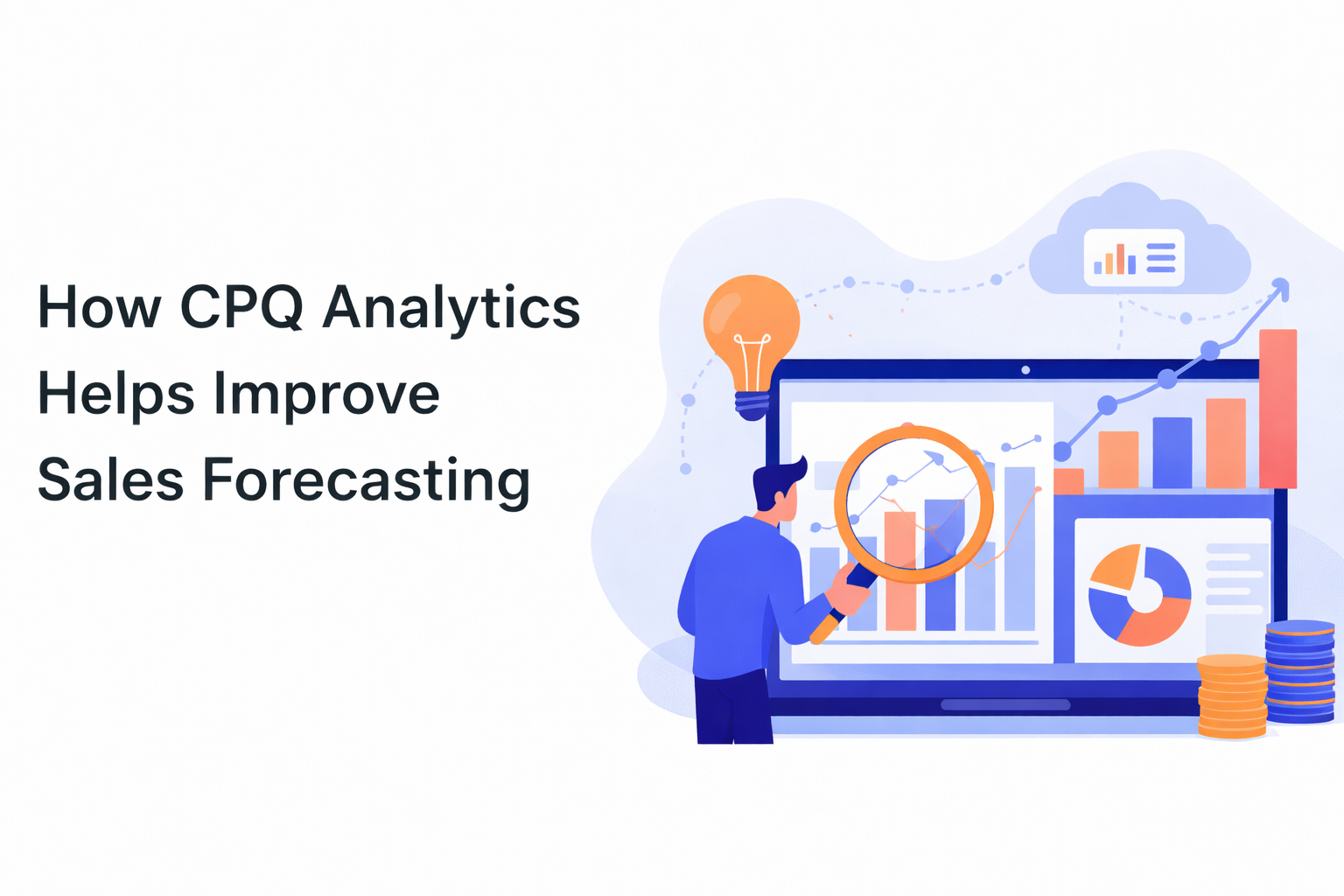
CPQ stands for Configure, Price, Quote. It is a software engine that handles complex pricing scenarios. CPQ analytics takes the data generated during the quoting process to win/loss ratios on specific configurations, discount depths, and margin impacts, and turns it into actionable intelligence.
Instead of looking at a CRM dashboard that just says a deal is worth $50,000, CPQ analytics tells you why it is worth that much. It breaks down the exact margins based on real-time material costs, labor constraints, and historical pricing trends.
Implementing CPQ results in a 46% drop in time spent fixing quoting errors. When complex errors aren’t caught immediately, your brand absorbs the cost. When they are caught instantly, the reps spend half their week doing math instead of closing wholesale orders. (Source: DealHub & Aberdeen Group CPQ Analysis, March 2026).
| Feature | Manual Spreadsheets | CPQ Analytics |
| Data Synchronization | Static. Updated manually once a quarter. | Dynamic. Tied directly to real-time PLM and ERP data. |
| Margin Visibility | Opaque. Reps offer discounts without seeing the COGS impact. | Transparent. Guardrails prevent quotes that drop below minimum margin thresholds. |
| Forecast Accuracy | Low. Based on optimistic rep guesswork. | High. Based on historically validated conversion rates and accurate BOMs. |
| Quote Speed | Days or weeks for complex custom orders. | Minutes, utilizing automated approval workflows. |
| “Margin erosion often stems from a reliance on discounting instead of value selling, and executive frustration stemming from limited visibility and poor sales forecasting. These issues aren’t caused by a lack of effort; they’re caused by a lack of alignment.”
— Lance Tyson, CEO, Tyson Group |
Using advanced pricing analytics changes how you predict future revenue. Here is how it directly improves your forecasting models.
Sales reps want to win deals. Without guardrails, they will discount aggressively to get a signature. CPQ software enforces hard rules. If a buyer wants a 20% discount on a custom order, the system instantly calculates the impact on the final margin. If it falls below your threshold, the system flags it for executive approval. Your forecast remains clean because it is no longer bloated by unprofitable revenue.
Forecasting isn’t just about total dollars; it is about knowing what you will sell. CPQ analytics tracks which specific configurations, materials, and product variations are most frequently quoted. If your analytics show a massive spike in quotes requesting organic cotton blends for Q3, your sourcing team can secure those materials now, preventing supply chain bottlenecks later.
Many modern brands are shifting toward complex pricing structures. By leveraging advanced CPQ solutions for subscription or usage-based models, you gain visibility into recurring revenue streams. You can forecast exactly when a wholesale partner is likely to reorder based on their historical consumption data, rather than waiting for them to call you.
Discover how our comprehensive solutions can streamline your workflows, boost productivity, and drive sustainable growth.
The most powerful aspect of CPQ analytics is integration. A standalone CPQ tool is helpful, but a CPQ connected to your PLM and sourcing modules is transformative.
When you introduce the role of AI in advanced CPQ solutions, you can automate smart pricing. The system can read external market signals, like shipping delays or raw material price spikes, and automatically adjust the baseline pricing in your quoting engine. Your reps are always quoting based on today’s reality, not last year’s spreadsheet.
When a quote is signed, that exact configuration flows seamlessly into your Supply Chain & WIP Tracking module. The factory knows exactly what to build because the tech pack and the sales quote are fundamentally aligned.
Forecasts built on broken data are just wishes. By replacing manual spreadsheets with robust CPQ analytics, you enforce margin discipline at the point of sale. You give your sourcing and production teams the accurate demand signals they need to operate efficiently. Stop guessing your revenue and start engineering it. Connect your sales floor to your factory floor, and watch your margins stabilize.
Ready to stop letting disconnected spreadsheets dictate your revenue? If your wholesale reps and sourcing teams are operating in silos, it is time to bridge the gap. Let’s look at your current quoting process and map out how GrexPro can protect your margins before the deal is even signed. Talk to Our Expert Today !
A: CRM reporting tracks the movement of a deal through the sales pipeline. CPQ analytics tracks the granular financial viability of the deal itself, analyzing margins, discount impacts, and product configuration trends before the deal is ever closed.
A: No. It accelerates them. Instead of waiting days for engineering or sourcing to approve a custom quote, CPQ uses pre-approved rules to generate accurate quotes instantly, drastically reducing the sales cycle.
A: Yes. A purpose-built CPQ system handles multi-dimensional product matrices effortlessly, ensuring that pricing rules are applied accurately across thousands of SKU variations simultaneously.
A: A robust CPQ system acts as the connective tissue between your front-end CRM and your back-end operations. Through native API integrations, it pulls real-time BOM data from your PLM and pushes approved orders directly to your ERP. This completely eliminates the manual dual-entry that causes costly production errors and delayed shipments.
A: Advanced CPQ platforms utilize dynamic pricing rules that automatically sync with your live costing data. If raw material or freight prices spike while a quote is being built, the system recalculates the margins instantly and flags any drop below your approved threshold. This prevents reps from locking in B2B wholesale orders that have suddenly become unprofitable.
 10th April 2026
 Surendra Yarrum