CPQ Implementation Cost: Pricing Factors, Timeline & Budget

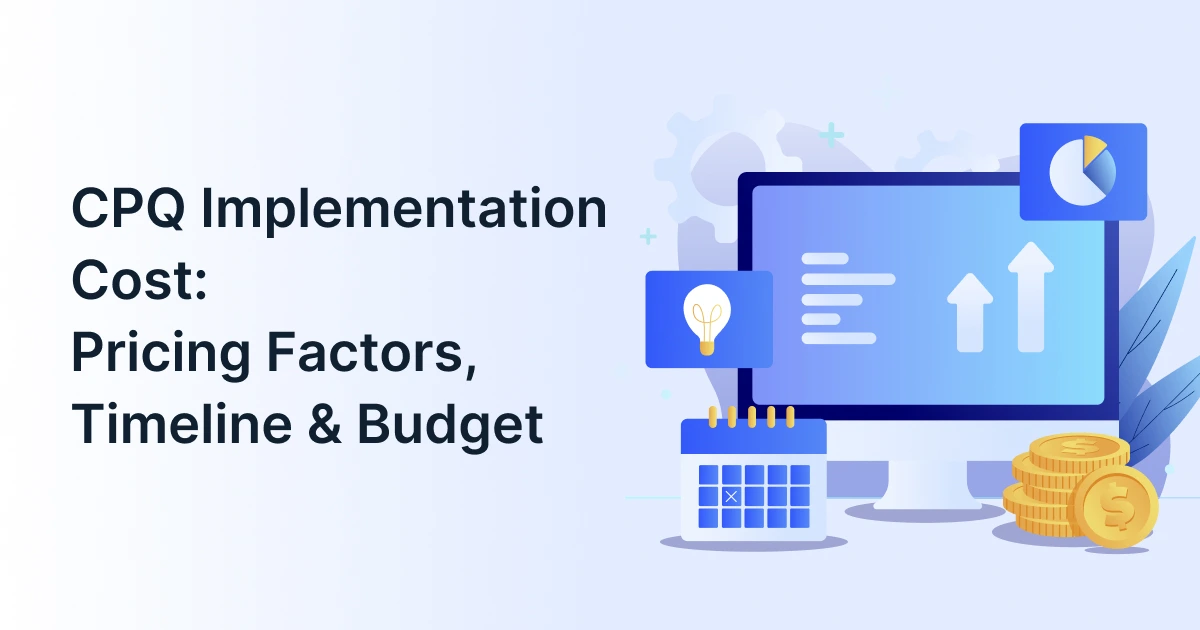
Implementing configure-price-quote software involves more than choosing a platform and paying subscription fees. Your CPQ implementation cost depends on product complexity, pricing rules, system integrations, and the scope of deployment. A clear budget helps you compare vendors, plan resources, and avoid unexpected expenses.
For B2B businesses and manufacturers, the objective is to implement CPQ software that supports accurate quotes without creating unnecessary implementation work. This guide explains the main pricing factors, expected timelines, and costs to consider before investing.
How Much Does CPQ Implementation Cost?
CPQ implementation cost varies based on the software platform, product catalog, customization, and integration requirements. Simpler deployments may cost a few thousand to tens of thousands of dollars, while complex enterprise implementations can reach six figures or more. These are broad planning categories, not standardized market prices.
For example, a business selling standardized products with basic discounts will usually require less configuration than a manufacturer managing hundreds of product variants and complex pricing conditions.
Before comparing quotes, separate the software subscription from implementation services. This gives you a clearer view of initial investment and recurring expenses.
When evaluating CPQ implementation pricing, ask vendors to explain their estimates against your specific requirements. A lower initial quote may exclude data migration, training, integrations, or ongoing support.

Which Factors Drive CPQ Implementation Pricing?
The biggest drivers of CPQ implementation cost are the complexity of your product catalog, pricing logic, integrations, and the amount of customization required. Each factor affects configuration effort, testing time, and the resources needed to launch.
Product Catalog and Configuration Complexity
A small catalog with standard options is relatively basic to configure. Products with interdependent components, bundles, compatibility restrictions, and engineered variants require more detailed configuration rules.
Pricing Rules and Approval Workflows
Tiered discounts, volume pricing, regional price lists, and customer-specific agreements add complexity. Approval workflows also need to reflect discount limits, authorization levels, and commercial policies.
CRM, ERP, and Other Integrations
Connecting CPQ with CRM, ERP, billing, and inventory systems requires accurate data mapping and testing. The number of systems, their existing architecture, and the quality of available APIs all influence the CPQ deployment cost.
McKinsey’s research on digital transformation in heavy-industry manufacturing highlights the importance of bringing data together across organizational silos. For CPQ projects, planning these data connections early can help reduce integration surprises.
Data Migration, Customization, and Training
Legacy product data may need cleaning before migration. Custom development, testing, employee training, and internal project management can add further expenses.
What Is Included in CPQ Setup Cost Beyond Licensing?
What costs should be included in a CPQ implementation budget?
Your CPQ setup cost should account for the full implementation, not just the software subscription.
| Cost component | What it covers |
| Software licensing | User subscriptions and feature tiers |
| Implementation services | Discovery, configuration, and deployment |
| Integration and migration | Connecting systems and preparing data |
| Testing and training | Quote validation and user onboarding |
| Ongoing maintenance | Administration, updates, and support |
Some expenses occur only during implementation, while others continue after launch. Subscription fees, for example, may recur monthly or annually. Product rule updates and administrative support may also require ongoing resources.
Ask vendors to specify what their proposal includes, which services cost extra, and how future changes will be priced. This makes it easier to compare proposals on an equal basis.
How Long Does a CPQ Implementation Take?
A CPQ implementation can take several weeks for a limited deployment or several months for a mid-market project. Large enterprise implementations may take six to twelve months or longer, depending on catalog complexity, integrations, and rollout scope.
A typical implementation follows these phases:
| Phase | Key activities |
| Discovery and planning | Define requirements, budget, and project scope |
| Configuration | Build product models, pricing rules, and approvals |
| Integration and testing | Connect systems and validate quote accuracy |
| Training and go-live | Prepare users and launch the solution |
The most effective way to manage the schedule is to agree on requirements early, assign decision-makers, and test representative quoting scenarios before expanding the rollout.
What Is the CPQ Implementation Cost for Manufacturers?
Why does CPQ implementation cost more for manufacturers?
The CPQ implementation cost for manufacturers depends heavily on product configuration requirements, engineering data, pricing variations, and ERP integration. Manufacturers selling engineered-to-order products often need more extensive rule modeling and validation than businesses selling standardized products.
Consider two scenarios:
- Standard product manufacturer: A limited product range, fixed pricing, and one ERP integration may require a relatively basic implementation.
- Complex product manufacturer: Multiple product families, configurable components, plant-specific pricing, and extensive ERP connections require more configuration, testing, and coordination.
Manufacturers must also ensure that configured quotes reflect technically valid products and can translate into accurate orders. This makes product data quality and testing especially important.
McKinsey’s research on manufacturing technology integration discusses the role of connecting engineering, manufacturing, and enterprise systems. Similar considerations apply when planning CPQ integrations with product and operational data.
For manufacturers, a realistic budget should account for product modeling, BOM-related data where applicable, integration work, and ongoing rule maintenance.

How Can You Keep Your CPQ Implementation Budget Under Control?
How can we reduce CPQ deployment costs?
A well-defined scope can help control CPQ deployment costs without compromising essential functionality.
- Prioritize core requirements: Start with the products and workflows that deliver the most immediate value.
- Document pricing rules: Agree on discount policies and approval thresholds before configuration begins.
- Prepare product data: Clean catalogs and standardize product attributes before migration.
- Limit unnecessary customization: Use standard platform features wherever they meet business requirements.
- Plan a phased rollout: Add product families or regions after validating the initial implementation.
- Clarify vendor fees: Confirm change request charges, support costs, and ongoing administration requirements.
Before signing a contract, request a detailed implementation scope, milestone schedule, list of exclusions, and estimate of recurring expenses. These details make CPQ implementation pricing easier to evaluate and help stakeholders approve a more realistic budget.
Conclusion
Estimating CPQ implementation cost requires looking beyond subscription fees. Product complexity, pricing rules, integrations, and rollout decisions all affect the final investment and delivery timeline. Manufacturers should pay particular attention to product data, engineering requirements, and ERP connectivity when planning their budgets.
GrexPro offers cloud solutions across B2B, ERP, WMS, and CPQ to support businesses with their operational and technology needs. By defining requirements early and evaluating the complete cost of ownership, your business can make a more informed CPQ investment and build a quoting process suited to its future growth.
FAQs
Q: What Is CPQ Pricing?
A: CPQ pricing refers to how configure-price-quote software calculates product or service prices using configuration options, pricing rules, discounts, and customer-specific conditions. It helps businesses generate quotes that follow their commercial policies.
Q: What Is a Price Rule in CPQ?
A: A price rule is a defined condition or calculation that determines how a product’s price changes during quoting. For example, a rule may apply a volume discount when an order exceeds a specified quantity. Available rule capabilities vary by CPQ platform.
Q: Does CPQ Software Have Ongoing Costs After Implementation?
A: Yes. Ongoing expenses may include software subscriptions, technical support, administration, product catalog updates, and changes to pricing rules or integrations.
Q: Can CPQ Be Implemented in Phases to Reduce Initial Costs?
A: Yes. Businesses can begin with selected product lines, pricing models, or regions and expand after validating the initial deployment. However, the phased approach should account for future integration and scalability requirements.
Q: How Can I Get an Accurate CPQ Implementation Estimate?
A: Provide prospective vendors with your product catalog, configuration rules, pricing policies, user requirements, existing systems, and rollout goals. Ask for an itemized proposal covering implementation services, licensing, integrations, training, and ongoing support.
Author
Managing Director of Grexpro
Surendra Yarrum is a Business Strategist at GrexPro with expertise in ERP, CRM, and warehouse management systems, helping businesses enhance efficiency and optimize supply chain operations.