Benefits & Use Cases of enterprise CPQ software for Sales Teams

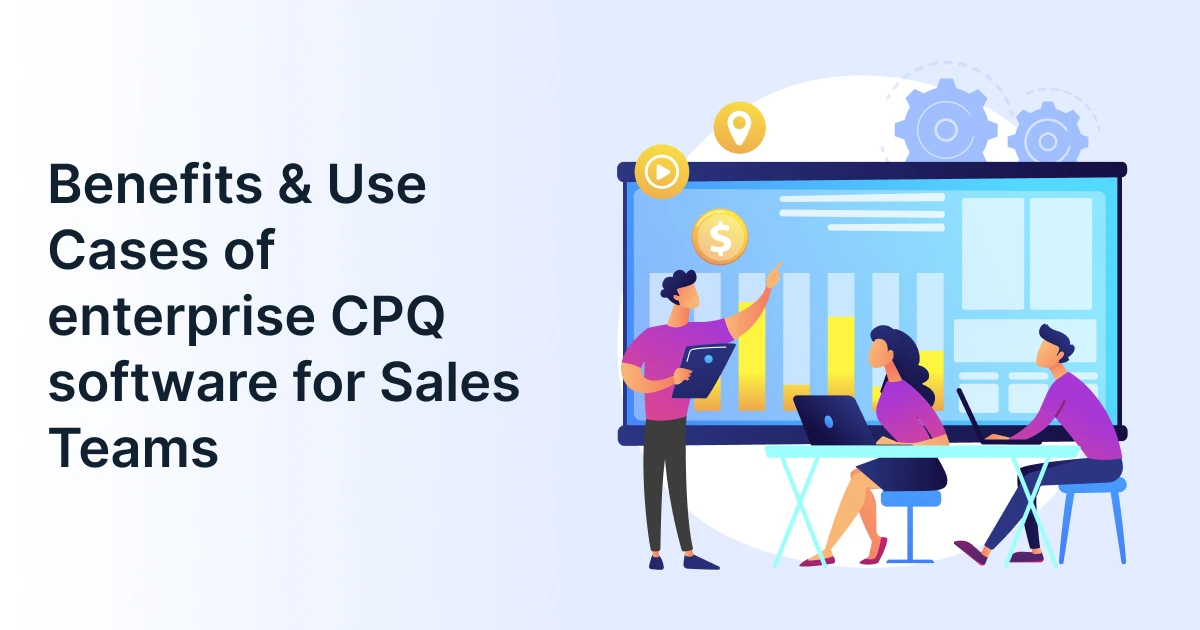
Enterprise sales teams deal with a lot more on a daily basis than simply sending quotes. Pricing is the most complex of all. Sales teams have to deal with different regions, custom discounts, bundled products, etc. It’s easy to make mistakes or second-guess what’s correct. On top of that, getting approvals isn’t quick. Quotes often bounce between managers, finance, and legal, slowing everything down and killing deal momentum.
Then there’s inconsistency. Two representatives might send completely different-looking quotes with different terms, which doesn’t inspire much confidence. Many teams still rely on spreadsheets or disconnected tools, so sales reps end up doing manual work instead of actually selling.
All of this adds up to delays, errors, and frustrated customers. And in a competitive market, slow or confusing quotes can mean missed opportunities. That’s why enterprise CPQ software is so important for sales teams.
In this blog, you’ll learn:
- What is enterprise CPQ software?
- Why enterprise sales teams need CPQ?
- Key benefits of CPQ solutions for enterprises.
- Use cases of CPQ solutions for enterprises.
- Challenges and best practices of enterprise CPQ software.
What is Enterprise CPQ Software?
Enterprise CPQ (Configure, Price, Quote) software is basically a smarter way for large sales teams to handle complex deals. Instead of juggling spreadsheets, emails, and multiple tools, everything comes together in one place. Sales reps can configure products, apply the right pricing, and build quotes without second-guessing or rework. It’s especially helpful when deals get complicated, with custom requirements or layered pricing. In simple terms, it reduces errors, saves time, and helps teams move deals forward without unnecessary delays.
Key Features of CPQ Solutions for Enterprises
- Automated quote management: Creates clean, accurate quotes without manual effort.
- Dynamic pricing rules: Automatically applies the right pricing based on set conditions.
- Approval workflows: Routes quotes to the right people without endless follow-ups.
- CRM & ERP integration: Keeps everything in sync so teams aren’t switching between tools.

Why Do Enterprise Sales Teams Need CPQ?
Practically speaking, manual quoting just doesn’t hold up in an enterprise setup. The system can disintegrate at any point of time. One wrong price, one missed approval, and suddenly the deal is stuck or, worse, lost. Sales teams spend more time fixing quotes than actually selling, which hurts both revenue and morale.
CPQ helps clean this up. It brings structure to quote management, keeps pricing in check, and supports better sales enablement by giving reps the tools they need to move faster. Instead of chasing approvals or reworking numbers, teams can focus on closing deals and building stronger customer conversations.
Common Challenges Without CPQ
- Inaccurate pricing: Manual inputs often lead to errors and margin leaks.
- Long approval cycles: Deals slow down with constant back-and-forth.
- Scaling issues: Quote management across regions goes out of hand pretty fast.
- Low visibility: Hard to track pipeline or get reliable sales forecasts.
Read more to know how CPQ Analytics helps improve sales forecasting.
What Are the Benefits of CPQ Solutions for Enterprises?
When you’re dealing with complex deals at scale, things can easily slow down or go off track. Hence, the importance of enterprise CPQ software for large businesses becomes undeniable. It simplifies how quotes are created, keeps teams aligned, and improves overall sales enablement. Tools like enterprise quote management software speed things up significantly. Plus, they make the entire sales process feel a lot more organized.
- Speed – Quotes that once took days or endless follow-ups can now be turned around in minutes. This helps sales reps respond while the deal is still warm.
- Accuracy – With built-in rules, pricing errors drop significantly. Nucleas Research notes that time spent fixing pricing errors drops by approx. 46% with CPQ.
- Scalability – Whether it’s 10 quotes or 10,000, the system handles it without breaking a sweat, even across global teams.
- Compliance – Pricing rules and approvals stay consistent, so every quote sticks to company policies without extra policing.
Which Use Cases Show CPQ’s Value in Large Businesses?
Enterprise CPQ software for large businesses is used across industries like manufacturing, SaaS, telecom, and healthcare. Let’s see the day to day use cases of the same.
| Use Case | Impact |
| Complex product configuration | Automates bundling and customization |
| Global pricing management | Ensures consistency across regions |
| Subscription-based services | Simplifies recurring billing quotes |
| Channel partner sales | Provides standardized pricing for resellers |
We’ll now move on to the ways how CPQ improves sales enablement in the next section.
How Does CPQ Improve Sales Enablement?
Honestly, most sales folks don’t struggle with selling. They struggle with everything around selling. Pricing checks, quote edits, approvals, it piles up. Hence, enterprise CPQ software for large businesses starts to feel like a relief. It takes a lot of that busy work off the table. And with enterprise quote management software, the process goes without constant nudging.
- Pricing shows up when you need it: No waiting around or sending quick checks to finance teams.
- Fewer wrong turns: The system keeps you on track while building quotes, so you don’t mess up configurations.
- Less time fixing stuff: You’re don’t have to go back and correct quotes all day.
- More actual selling: Less screen time, more customer time is the output that you get with CPQ integration.
- Backed by numbers: Teams using CPQ see quoting efficiency jump significantly within days.
To give you an example, according to Prospeo, businesses that use CPQ speed up quote management by 10X and reduce approval time by 95%.
What Challenges Should Enterprises Expect in CPQ Implementation?
Bringing in enterprise CPQ software sounds straightforward. However, it’s not a smooth ride all throughout. Most teams working with CPQ solutions for enterprises hit a few common roadblocks. To be honest, the obstacles are more about people and data than the tool itself. Let’s see the challenges in detail.
- Data needs cleanup first: There’s always some inconsistency hiding in factors like pricing sheets, product catalogs, customer data, etc.
- Adoption takes time: Sales reps don’t drop old habits overnight, even if the new system is better.
- Older systems can slow things down: Integrating with legacy CRM or ERP is a complex process that needs patience.
- Loose processes get exposed: Things that worked somehow before now need proper structure after the implementation. This in turn may bring ambiguities into the process.
- Trying to overbuild early: Going too heavy on customization upfront usually delays everything.
Let’s now look at the best practices while implementing CPQ solutions for enterprises to avoid the above-mentioned challenges.
Learn more about common CPQ implementation mistakes to avoid.

Best Practices to Implement Enterprise CPQ Software
Let’s see the steps that certain teams follow to reap maximum profits from CPQ solutions for enterprises. The basic formula is to not overcomplicate or rush things. If teams ensure they get the basics right, they can build the rest of the process from there. With enterprise CPQ software, that approach tends to work better anyway. Let’s jot down the best practices one by one.
- Start with a small rollout: One region or team is enough to test things properly.
- Make it relevant for sales reps: Show how it saves their time. Then adoption follows naturally.
- Get integrations sorted early: Connecting CRM and ERP upfront avoids complicated fixes later.
- Keep the setup simple: You don’t need to solve every edge case on day one.
- Track usage and tweak things: Watch how the team uses it, fix what feels off, and keep improving.
Key Statistics
- According to Gartner, 49% of B2B companies report faster sales cycles after CPQ adoption
- According to Forrester, CPQ reduces quote errors by 40%
- According to McKinsey, enterprises using CPQ see 20–30% higher win rates
Key Takeaways
- Enterprise CPQ software is essential for large businesses managing complex quotes.
- Benefits include speed, accuracy, compliance, and scalability.
- Use cases span industries from SaaS, healthcare to manufacturing.
- Implementation challenges can be overcome with best practices.
Conclusion
Enterprise CPQ software transforms how sales teams operate. It makes quoting faster, smarter, and more scalable. For enterprises, it’s so much more than a tool. It’s a competitive advantage.
FAQs
Q: What is enterprise CPQ software?
A: Enterprise CPQ software automates configure, price, quote processes for large businesses, ensuring faster and more accurate quotes.
Q: How does CPQ improve sales enablement?
A: CPQ provides guided selling, real-time pricing, and analytics, enabling sales teams to focus on customer engagement instead of admin tasks.
Q: Which industries benefit most from CPQ?
A: Industries like manufacturing, SaaS, telecom, and healthcare benefit due to complex pricing and global operations.
Q: What challenges occur during CPQ implementation?
A: Challenges include data migration, integration with legacy systems, and user adoption. Best practices help overcome these.
Q: Is CPQ software scalable for global enterprises?
A: Yes, enterprise CPQ software is designed to handle thousands of quotes across regions, ensuring consistency and compliance.
Author
Managing Director of Grexpro
Surendra Yarrum is a Business Strategist at GrexPro with expertise in ERP, CRM, and warehouse management systems, helping businesses enhance efficiency and optimize supply chain operations.