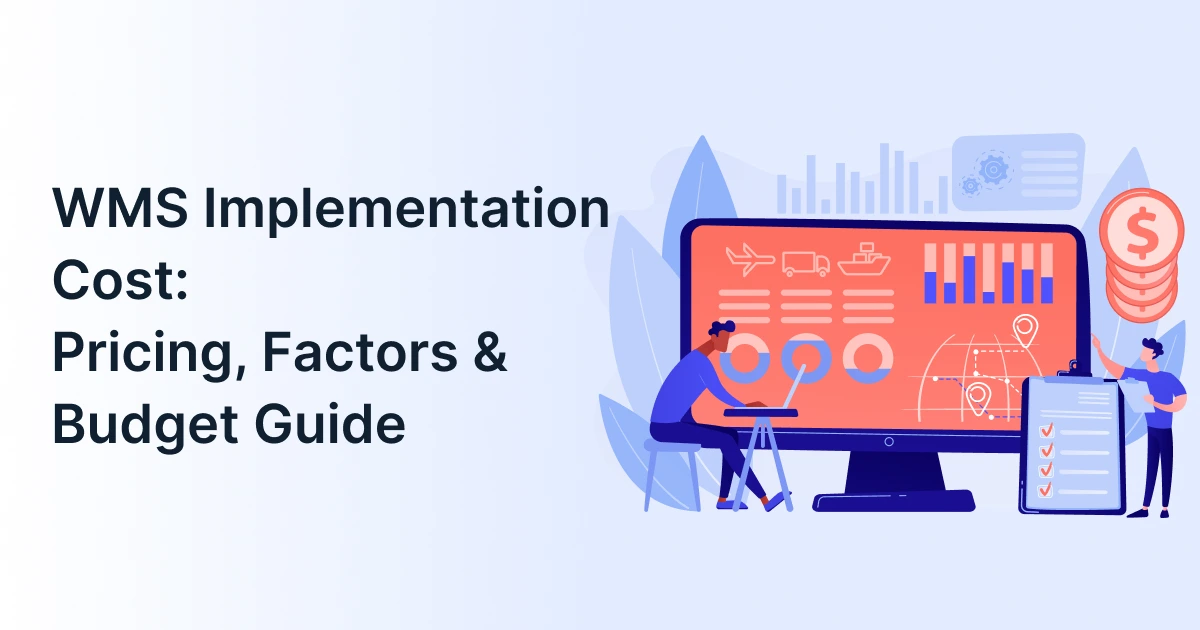
WMS Implementation Cost: Pricing, Factors & Budget Guide

The WMS implementation cost varies from one business to another. There is no universal price for implementing a warehouse management system. Warehouse size, workflows, integrations, data quality, customization, and deployment model all affect the final investment.
The WMS implementation cost also differs from the warehouse software cost. Software covers the platform or subscription. Implementation covers the work needed to configure, integrate, test, migrate, and launch it.
This distinction matters when comparing vendor proposals. A lower software quote may still lead to higher implementation spending. Buyers should therefore evaluate the complete budget and long-term ownership cost.
McKinsey estimates that companies globally spend about €300 billion each year on warehousing. More than 85% goes toward operating costs.
That makes warehouse technology a business investment. It should be assessed beyond the initial WMS setup cost.

What Is the Average WMS Implementation Cost?
There is no reliable universal average for WMS implementation cost. Each implementation has a different scope. A small single-site operation may need limited configuration. A global network may need extensive integration and rollout support.
A practical budget should separate the warehouse software cost from related implementation expenses.
| Cost component | What it typically covers |
| WMS software | Subscription or software license |
| Implementation | Configuration, testing, and deployment |
| Integrations | ERP, e-commerce, carriers, and other systems |
| Data migration | Data cleansing, mapping, transfer, and validation |
| Hardware | Scanners, printers, mobile devices, and related equipment |
| Training | Admin, supervisor, and warehouse-user training |
| Support | Post-go-live assistance and maintenance |
The WMS implementation pricing should show these costs separately. This makes vendor proposals easier to compare.
The WMS implementation cost can also change when the project expands. More sites, workflows, users, integrations, and custom requirements usually create more implementation work.
So, treat any quoted WMS implementation pricing as scope-specific. Ask what the quote includes before comparing it with another vendor.
You can also refer to this table to find out the estimated costs for your business.
| Operation | Indicative implementation profile |
| Small/simple warehouse | Lower-cost cloud implementation with limited integrations |
| Growing/mid-market operation | Configuration + multiple integrations + migration + training |
| Multi-site/complex operation | Significant integration, customization, automation and rollout work |
| Enterprise/automated network | Highly scoped implementation requiring detailed vendor assessment |
Which Factors Increase WMS Implementation Cost?
Several factors can increase the WMS implementation cost. The biggest drivers usually relate to operational complexity and technical scope.
| Cost factor | Why it affects implementation |
| Number of warehouses | Each site may need separate setup and testing |
| Warehouse complexity | More workflows require more configuration |
| Integrations | Each connection needs mapping and testing |
| Customization | Custom workflows require additional development |
| Data migration | Poor data needs cleansing and transformation |
| Automation | Equipment requires additional interfaces |
| Users and roles | More roles can increase setup and training |
| Compliance | Special controls may require extra configuration |
Warehouse size and process complexity
A warehouse handling simple storage needs less configuration. Complex operations need more process mapping.
These may include wave picking, cross-docking, batch tracking, serial tracking, returns, or multi-step putaway.
The WMS setup cost therefore depends on more than warehouse square footage. The number of processes matters, too.
Integrations with existing systems
Most businesses do not operate a WMS in isolation. The system may connect with ERP, ecommerce, transportation, order management, or carrier platforms. SAP identifies data migration and integration as important parts of implementation planning. Oracle also notes that warehouse integrations can require planning around data mapping, transformations, and transaction volumes.
These requirements can increase both WMS implementation pricing and project timelines.
Customization and automation
Customization can increase the WMS deployment cost. The same applies to automation interfaces.
Automated storage and retrieval systems, robotic equipment, and warehouse control systems can require additional integration work. Oracle documents WMS integrations with ASRS, robotic arms, and other warehouse control systems.
This is why buyers should distinguish configuration from custom development. Configuration uses existing capabilities. Customization adds project-specific development.
How Does Deployment Model Affect WMS Pricing?
The deployment model changes the structure of WMS implementation pricing. Cloud, on-premises, and hybrid deployments can involve different infrastructure and support requirements.
| Deployment model | Typical cost structure | Main budget consideration |
| Cloud/SaaS | Subscription + implementation | Recurring software cost |
| On-premises | License + infrastructure + implementation | Higher infrastructure responsibility |
| Hybrid | Software + infrastructure + implementation | Environment and integration complexity |
A cloud WMS can reduce the need for customer-managed infrastructure. However, it does not remove implementation work.
Configuration, integration, migration, testing, and training still require planning. These activities remain part of the WMS deployment cost.
On-premises deployments can add infrastructure and maintenance requirements. Hybrid models may introduce additional integration work.
The right comparison should therefore consider the complete warehouse software cost. It should also include implementation and ongoing ownership expenses. IBM defines TCO as the total cost of a product or service across its lifecycle. This includes direct and indirect costs.
That principle applies when comparing WMS deployment costs across different models.
What Should Your WMS Implementation Budget Include?
A realistic budget should cover the entire implementation lifecycle. The WMS implementation cost should not stop at configuration.
Before implementation
- Process discovery
- Requirements analysis
- Solution design
- Data assessment
- Integration planning
During implementation
- System configuration
- Custom development
- Integration
- Data migration
- System testing
- User acceptance testing
At go-live
- Production deployment
- User training
- Hardware setup
- Go-live support
- Initial issue resolution
After go-live
- Technical support
- Maintenance
- Enhancements
- Additional sites
- Additional integrations
This approach gives buyers a clearer view of the WMS setup cost.
It also helps prevent unexpected expenses after signing up. Oracle recommends planning implementation around scope, data migration, integrations, testing, training, and ongoing maintenance.
Also, ask every vendor whether each item is included, estimated separately, or excluded.
This simple step can make WMS implementation pricing much easier to compare.

How Do You Calculate the Total WMS Budget?
A useful starting formula is:
Total WMS budget = Software + Implementation + Integrations + Data migration + Hardware + Training + Support + Contingency
Start with the first-year WMS implementation cost. Then estimate the cost across three to five years.
| Cost area | Year 1 | Years 2–3 |
| Software subscription | ✓ | ✓ |
| Implementation | ✓ | — |
| Integrations | ✓ | As needed |
| Hardware | ✓ | Replacement/additions |
| Training | ✓ | Refresher training |
| Support | ✓ | ✓ |
| Enhancements | As needed | ✓ |
This creates a more useful view of WMS software cost.
It also prevents buyers from focusing only on the first invoice. IBM recommends considering initial, operating, maintenance, and other lifecycle costs when calculating TCO.
Warehouse expenses can also vary significantly between operations. McKinsey recommends bottom-up cost analysis because broad benchmarks may miss differences in products, order patterns, service levels, labor, space, and equipment.
The same principle applies to WMS implementation cost. Build the budget around your operation.
How Can You Control WMS Implementation Costs?
Controlling WMS implementation cost does not mean removing important capabilities. It means managing the scope carefully.
Start with the workflows that affect daily warehouse execution. Prioritize receiving, put away, inventory, picking, packing, and shipping.
Use standard configuration where possible. Avoid customization when the business process can adapt without operational risk.
Clean legacy data before migration. Poor-quality data can add preparation and validation work.
Define integrations before requesting proposals. This gives vendors a clearer scope.
Also, plan for future warehouses and users. A cheap initial design may create higher costs during expansion.
Finally, ask vendors for line-item WMS implementation pricing. The proposal should identify included work, exclusions, assumptions, and change-request rates.
This makes the WMS implementation cost easier to control from the start.
What Should You Ask a WMS Vendor Before Signing?
A vendor discussion should cover more than the WMS software cost. Ask questions that expose the complete implementation scope.
- What exactly is included in the implementation fee?
- Which integrations are included?
- How are additional customizations priced?
- Is data migration included?
- Are devices and hardware integrations included?
- What are post-go-live support costs?
- How are additional warehouses priced?
- What happens if the project scope changes?
Also ask how the vendor calculates the WMS setup cost. Request assumptions behind the quote.
This can reveal differences between two proposals that appear similar initially.
Conclusion
A realistic WMS implementation cost starts with the operation, not the software quote. Warehouse complexity, integrations, migration, customization, hardware, and support all influence the final budget.
Businesses should compare WMS implementation pricing using the same scope. They should also separate WMS deployment cost, WMS setup cost, and recurring warehouse software cost.
A structured evaluation can make the investment easier to plan. It can also reduce surprises during implementation.
GrexPro helps businesses adopt cloud-based WMS software with solutions designed around modern warehouse operations.
FAQs
Q: How much does WMS implementation cost?
A: The WMS implementation cost depends on the scope. Warehouse complexity, integrations, data migration, customization, and deployment all affect it.
Q: What is included in WMS implementation pricing?
A: WMS implementation pricing can include configuration, integrations, migration, testing, training, deployment, and support. Confirm each item with the vendor.
Q: What is WMS deployment cost?
A: WMS deployment cost includes expenses linked to launching the system. It can include implementation services, infrastructure, integrations, migration, testing, and training.
Q: How much does warehouse software cost?
A: Warehouse software cost varies by licensing model, users, facilities, functionality, and contract structure. Subscription pricing should not be treated as the full project cost.
Q: What is included in WMS setup cost?
A: The WMS setup cost can include configuration, workflows, user roles, locations, master data, devices, testing, and initial training.
Q: Is cloud WMS cheaper than on-premises WMS?
A: Not necessarily. Cloud and on-premises models have different cost structures. Compare software, infrastructure, implementation, support, and long-term TCO.
Q: Why does WMS implementation pricing vary between vendors?
A: WMS implementation pricing varies because vendors may define scope differently. One quote may include migration and integration. Another may charge them separately.
Author
Managing Director of Grexpro
Surendra Yarrum is a Business Strategist at GrexPro with expertise in ERP, CRM, and warehouse management systems, helping businesses enhance efficiency and optimize supply chain operations.