 28th June 2023
LEADING TECH INNOVATIONS IN WAREHOUSE MANAGEMENT
Technology in all sectors of the economy is progressing at a rapid pace. It also helps reduce the supply chain, increasing the speed of product movement. Warehouses must have the technologies necessary to keep up with manufacturing, consumer demand, and production. Automation increases productivity, efficiency, and accuracy in a smart warehouse, and the solutions provide personnel and process more flexibility.
Before discussing the technologies used in warehouse management, which help them to keep flexible, functional, and effective, let’s look at the advantages of using technologies for warehouse management.
Benefits Of Using Technologies For Warehouse Management
- In addition to a reduction in human error, lower risk of injury, and optimization throughout, your automation reduces your overheads, adds flexibility to your hours of operation, and allows you to be more accurate in assessing your workforce requirement.
- Using technologies in warehouses reduces human error and the risk of injury.
- Another important benefit of using a smart warehouse is the intervention of Lower operation costs.
- Technologies help improve warehouses’ efficiency and optimize the workflow of various fulfillment operations.
- Smart warehouses help in increasing efficiency and provide customer satisfaction.
Let’s Discuss the Important Techniques or Innovations Essential in Warehouse Management.
Ready to transform your business operations?
Discovr how our comprehensive solutions can streamline your workflows, boost productivity, and drive sustainable growth.
1. Internet Of Things
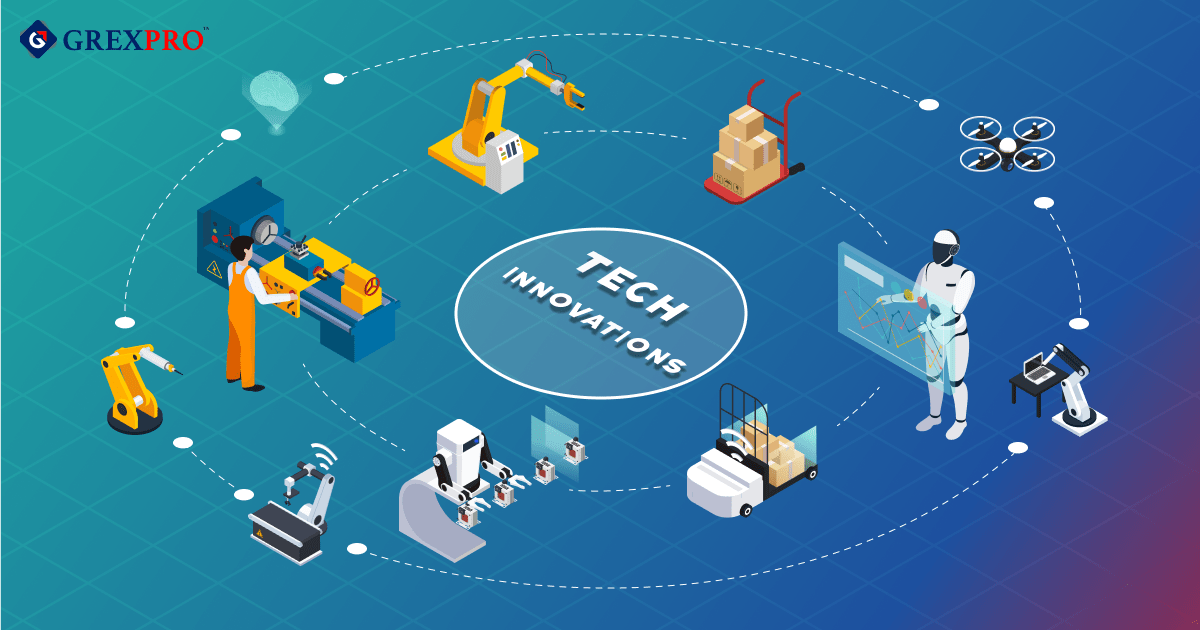
The Internet of Things (IoT) is a very popular and advanced technology used in warehouse management.
The interconnection of physical objects that can vary from computers to non-computer objects embedded with sensors is a real work of The Internet of Things. It helps to form an ecosystem of smart items that can exchange and capture data in real time.
Organizations now have more visibility into every aspect of the warehouse, from receiving to shipping. Also, the application of IoT may vary from keeping track of machinery/infrastructure health to monitoring the movement and use of assets across the facility utilizing sensors.
2. Robotics and Automation
One of the crucial technologies used in warehouse management is Robotics and automation. With minimal or no human assistance, warehouse operations can be performed autonomously.
Robotics and automation are essential to streamline operations because the warehouse is full of repeatable, process-oriented, and error-prone procedures.
Robotics and automation technology help to improve employee engagement and retention rates as the repetitive and dull tasks are transferred to the robots, which makes the warehouse more efficient while tackling different operational roles.
3. Predictive Analysis and Business Intelligence
As warehouses generate large amounts of data, such technology can help analyze and convert data into insights. Based on information gathered from warehouse operations, business intelligence generates aggregated reports and real-time dashboards. On the other hand, predictive analytics technology uses techniques such as data mining, statistics, and artificial intelligence using current or historical data and forecasts possible outcomes.
4. Artificial Intelligence
Another popular technology used in warehouse management is Artificial Intelligence. This technology enables machines to perform human-like tasks such as speech recognition, decision-making, spatial awareness, and visual perception. In the warehousing industry, AI plays a vital role on a large scale using common practices like web-based AI chatbots. The function of AI technology in warehouses is used for semi-automating warehouse processes. The companies can resolve customer queries without any interaction of manpower.
5. Warehouse management systems
The Warehouse Management system is also known as WMSs. This software technology allows organizations to control and administer warehouse operations from when goods or materials enter a warehouse until they move out.


 Surendra Yarrum