 29th January 2026
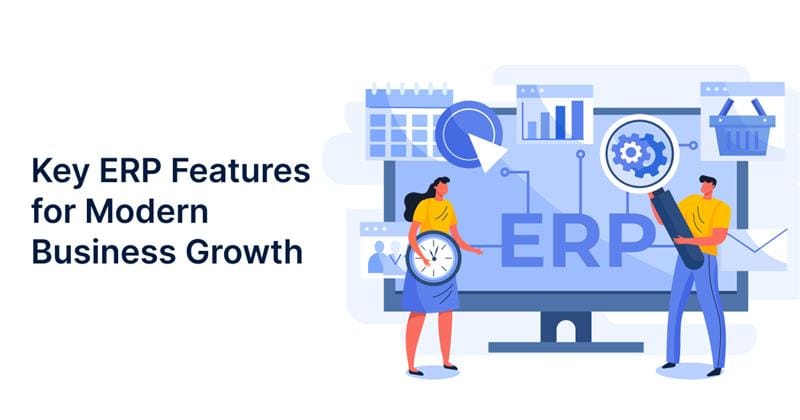
Key ERP Features for Modern Business Growth
Introduction: Why ERP Capabilities Define Business Scalability Today
According to reports, over 95% of organizations report improved process visibility after ERP adoption, yet many fail to scale due to selecting the wrong ERP features. Modern businesses struggle with fragmented data, manual reporting, and delayed decision-making as operations grow.
This is where a robust enterprise resource planning software becomes critical. Instead of acting as a simple back-office tool, ERP now functions as a strategic growth engine. Businesses that align technology with operational goals gain efficiency, agility, and long-term resilience. This blog explores the key features of ERP that directly support sustainable business growth, focusing on real operational value rather than generic software checklists.
“When managers of a company select an ERP package to implement, they are ‘buying into’ the ERP vendor’s view of a certain industry’s best practices and relying on the system to support their efforts to embrace these practices.”
— Marianne Bradford, ERP expert and author
Unified Data Management as the Backbone of ERP Systems
Centralized data management is one of the most influential features of the ERP systems. The problem of data silo is a major operation risk as businesses grow in different sections. ERP systems bring together data on finance, operations, human resource, and supply chain into one system of record.
This enhances the accuracy of data and uniformity between teams. An integrated enterprise resource management network will enable leaders to rely on dashboards and reports without verifying several sources. In the case of expanding companies, it will save the decision latency and compliance risks and allow faster cross-functional cooperation. Scalability is also supported with centralized data; hence growth does not affect control or governance.
Streamline Operations & Drive Smarter Growth
Looking to optimize workflows, reduce inefficiencies, and scale faster? Discover how GrexPro’s intelligent solutions can transform the way your business works.
Core ERP Modules That Support End-to-End Operations
The effectiveness of an ERP platform depends heavily on its core ERP modules. These modules structure business processes while allowing flexibility for industry-specific needs. Instead of operating in isolation, modern ERP modules are designed to work together seamlessly.
Common core modules include:
- Finance and Accounting: Manages budgets, reporting, and compliance in real time
- Supply Chain and Inventory: Optimizes procurement, storage, and fulfillment processes
- Human Resources: Supports workforce planning, payroll, and employee lifecycle management
When integrated effectively, these modules enhance ERP functionality by reducing duplication and improving operational flow across teams.
Process Automation as a Growth Enabler
Manual processes limit scalability. Standardization of workflows in all departments is one of the most useful ERP software features as they contain an inbuilt automation. Automation lessens the reliance on manual approvals, data repetition and error-prone reporting processes. The current ERP capabilities have workflow that is rule based and can adjust itself to business logic without always having to make changes in the system.
This is to guarantee consistency as well as flexibility. In the case of expanding organizations, automation enables the teams to dedicate themselves to strategic work as opposed to administrative duties. In the long-term, it results in accelerated performance, alleviated operational risk and enhanced productivity throughout the enterprise.
ERP Feature Mapping: From Functionality to Business Value
The table below explains ERP features in a practical, non-statistical way by mapping them to business outcomes. This helps decision-makers understand how ERP system features translate into real operational benefits.
| ERP Feature Area | Description | Business Value |
| Centralized Database | Unified data across departments | Improves accuracy and decision confidence |
| Modular Architecture | Independent yet integrated modules | Enables scalable growth |
| Workflow Automation | Standardized process execution | Reduces delays and manual effort |
| Role-Based Access | Controlled system permissions | Enhances security and accountability |
| Integration Capability | Connects ERP with external tools | Ensures smooth data flow |
| Reporting & Dashboards | Real-time operational insights | Supports faster decision-making |
Real-Time Reporting and Decision Support
Access to timely insights is a critical key feature of ERP for modern enterprises. ERP platforms provide real-time dashboards that consolidate operational, financial, and workforce data into actionable views. This eliminates the need for delayed reporting cycles and manual data consolidation.
Integrated reporting enhances ERP functionality by supporting proactive management instead of reactive problem-solving. Leaders gain visibility into performance trends, resource utilization, and operational risks. For organizations navigating growth, real-time insights enable quicker course correction and more confident strategic planning.
Scalability and Deployment Flexibility
Scalability will help to ensure that an ERP system expands with the growth of the business as opposed to censoring its growth. Flexibility in deployment enables the organizations to change their ERP environment as required by the changes in the operational requirements.
Cloud and hybrid deployment services
Empower businesses to scale users, location and functions without infrastructure tiers and system failures.
Modular expansion capability
Enables organizations to expand or modify ERP modules when new needs emerge without needing complete system overhaul.
Support for geographic and operational growth
Provides the capability of the system to accommodate multi-location operations, various regulations, and growing business models of the ERP system.
Security, Compliance, and Control
As organizations scale, maintaining data security and regulatory compliance becomes increasingly complex. Modern ERP systems embed governance and control mechanisms directly into core operations.
- Role-based access control
Restricts system access based on job roles, reducing the risk of unauthorized data exposure.
- Built-in audit trails and monitoring
Tracks system activities to support transparency, accountability, and regulatory reporting.
- Automated compliance enforcement
Helps organizations meet industry and legal requirements without adding manual oversight or operational burden.
Ready to transform your business operations?
Discover how our comprehensive solutions can streamline your workflows, boost productivity, and drive sustainable growth.
Integration-Ready ERP Ecosystems
The modern business world is based on various online tools. The next useful ERP software feature is the possibility to be easily integrated with CRM, analytics, and industry specific platforms. ERP systems integrating are available to avoid data silo-es without losing flexibility.
This improves the functionality of ERP as it enables organizations to innovate without changing the core systems. An integrated ERP ecosystem is known to assist in enhancing customer experiences, better analytics, and streamline operations throughout the digital stack.
Grexpro’s Approach to ERP Enablement
Grexpro focuses on delivering ERP solutions that align operational needs with long-term growth objectives. Their approach emphasizes modular design, scalability, and practical ERP features that support real business workflows. Rather than promoting complexity, Grexpro prioritizes clarity, adaptability, and operational alignment.
By supporting configurable enterprise resource planning software, Grexpro enables organizations to scale without losing control or visibility. Their expertise lies in translating ERP capabilities into measurable business outcomes.
Building an ERP Strategy That Grows with You
ERP success depends on selecting features that align with business goals, not just current needs. Organizations should evaluate scalability, integration, and workflow support before implementation. To build long-term operational resilience, explore more about how a thoughtful ERP strategy can support sustainable growth and smarter decision-making.
FAQs:
Q: What are the most important ERP features for modern business growth?
A: The most critical ERP features include centralized data management, scalable core ERP modules, workflow automation, and integration-ready architecture.
Q: How do core ERP modules improve operational efficiency in growing businesses?
A: Well-integrated core ERP modules streamline finance, supply chain, and HR operations, reducing duplication and improving cross-functional coordination.
Q: Why is ERP functionality essential for data-driven decision-making?
A: Strong ERP functionality provides real-time dashboards and unified reporting, enabling leaders to make faster and more informed decisions.
Q: Which ERP system features support scalability and long-term expansion?
A: Cloud deployment, modular architecture, and flexible user management are ERP system features that allow organizations to scale without operational disruption.
Q: How does enterprise resource planning software reduce operational risk?
A: Modern enterprise resource planning software includes security controls, audit trails, and compliance mechanisms that help minimize operational and regulatory risks.
Q: How does Grexpro help businesses select the right ERP features?
A: Grexpro aligns enterprise resource management system capabilities with business goals, ensuring ERP solutions support sustainable growth.

 Surendra Yarrum