 21st January 2026
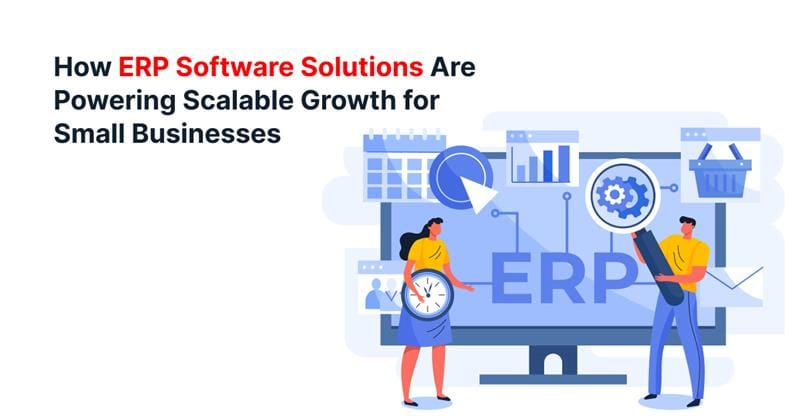
How ERP Software Solutions Are Powering Scalable Growth for Small Businesses
Introduction: Why ERP Is Becoming Mission-Critical for Small Businesses
The current business environment of small businesses is volatile and cost control; visibility of operations and rate of execution is the competitiveness factor. Separated accounting, inventory, human resources, and sales tools usually cause data silos and slow decision-making. This is where ERP of Small Business comes in to transform the situation by integrating the operations under one system of record.
The contemporary ERP systems are not exclusive to the enterprise. They are expandable, portable and affordable to expanding companies. According to industry research, more than 68 percent of small businesses that move to ERP systems record process efficiency within the first year. With digital maturity starting to be a survival aspect, ERP software is already becoming baseline infrastructure as opposed to an upgrade.
What Makes ERP Systems Relevant for Small Companies Today
In contrast to the old-fashioned software, new ERP systems of small businesses are created to facilitate lean teams and quick decision making. They combine finance, supply chain, CRM, and compliance processes on a single platform and eliminate reliance on manual reconciliation.
The greatest benefit is real time visibility across departments, and this helps business owners to be quicker at responding to business operational problems. A small business ERP system offers simplicity with a structure to small businesses that are going through the growth phase with limited resources. The existence of this balance enables the leadership teams to concentrate on strategy rather than firefighting on a daily basis.
Key operational benefits include:
Here’s a short, clear elaboration of each bullet point, keeping it concise and professional:
- Centralized data control: All business data is stored in a single system, reducing duplicate entries, minimizing errors, and enabling faster, more accurate reporting across departments.
- Process standardization: ERP enforces uniform workflows for finance, operations, and inventory, ensuring teams follow consistent procedures and reducing dependency on manual work.
Streamline Operations & Drive Smarter Growth
Looking to optimize workflows, reduce inefficiencies, and scale faster? Discover how GrexPro’s intelligent solutions can transform the way your business works.
Cloud ERP: The Preferred Deployment Model for Small Businesses
The rapid shift toward cloud ERP for small business adoption is driven by flexibility, lower upfront costs, and faster implementation timelines. Cloud-based ERP eliminates the need for heavy IT infrastructure and allows teams to access systems securely from anywhere.
In 2025, studies show that over 72% of small businesses prefer cloud-hosted ERP platforms due to predictable subscription pricing and automatic updates. These systems scale as the business grows, avoiding costly migrations. A well-implemented ERP software for small businesses in the cloud also improves data security through enterprise-grade encryption and compliance controls. This makes cloud ERP a strategic choice rather than a technical one.
Key Capabilities That Define the Best ERP for Small Business
Selecting the best ERP for small business requires aligning technology capabilities with operational priorities. The most effective platforms focus on usability, automation, and analytics rather than feature overload. Financial management remains the core module, but inventory optimization, procurement tracking, and customer data integration are equally critical.
For decision-makers, dashboards that convert raw data into insights are essential. A future-ready ERP for Small Business must also support API integrations to connect with existing tools.
| ERP Capability | Business Impact |
| Financial automation | Faster month-end closures |
| Inventory visibility | Reduced stockouts |
| Real-time reporting | Better decision accuracy |
Implementation Challenges and How Small Businesses Overcome Them
ERP adoption is not without challenges, especially for smaller organizations with limited change-management capacity. Common barriers include:
- User resistance to change: Employees may hesitate to adopt new systems, but structured training and role-based access help improve confidence and acceptance.
- Data migration complexity: Moving data from multiple tools can be challenging; small businesses overcome this by cleaning data beforehand and migrating in phases.
- Limited internal IT expertise: Many small firms lack dedicated IT teams, which is addressed by choosing intuitive ERP platforms with strong vendor support.
- Unclear process ownership: Defining clear roles and responsibilities before implementation ensures accountability and smoother system adoption.
- Budget and time constraints: Phased rollouts allow businesses to implement critical modules first, reducing upfront costs and operational disruption.
Best practices include:
- Centralized data control: All departments access a single source of truth, which eliminates duplicate data entries, reduces errors, and enables faster, more reliable reporting.
- Process standardisation: Standard workflows across teams ensure tasks are executed consistently, improving efficiency, accountability, and overall operational alignment.
Industry Trends Shaping ERP Software for Small Businesses
ERP systems are changing at a very fast rate as AI-based forecasting, automation, and predictive analytics are now common characteristics. These inventions also enable the small business to compete with the bigger business using intelligent insights.
Small business modern ERP software has now automation of workflow, anomaly detection and role-based analytics. This pattern is transforming the nature of how leadership teams strategize and handle risk. With the rising regulations and expectations of customers, ERP systems are emerging as engines of compliance in addition to working tools.
Ready to transform your business operations?
Discover how our comprehensive solutions can streamline your workflows, boost productivity, and drive sustainable growth.
How Grexpro Approaches ERP for Small Businesses
Applications such as Grexpro are dedicated to the provision of customizable ERP that is relevant to the real-life small business requirements. Grexpro helps organizations with fragmented systems to migrate to a single system by focusing on scalability, usability, and integration preparation. Their style is indicative of the industry trend of flexible ERP model of Small Business that expands with the organization.
The emphasis is not put on the complexity, but rather on the clarity of operations and long-term value. This philosophy fits the prevailing trends of ERP adoption in which business enterprises pursue long-term digital platforms rather than short-term solutions.
Making Informed ERP Decisions
Choosing the right ERP solution is a strategic decision that impacts operations, finance, and growth. Business leaders should evaluate systems based on scalability, deployment flexibility, and long-term usability. Exploring platforms like Grexpro can provide valuable insight into how modern cloud ERP for small business solutions are structured. An informed approach ensures ERP becomes a growth enabler rather than a cost centre.
FAQs
Q: What is the ideal ERP for Small Business in 2026?
A: The ideal ERP for Small Business in 2026 is cloud-based, scalable, and analytics-driven. It should support finance, inventory, and reporting without heavy customization.
Q: How does cloud ERP for small business reduce costs?
A: Cloud ERP for small business reduces infrastructure and maintenance costs through subscription pricing and automated updates, improving ROI over time.
Q: Are ERP systems for small companies difficult to implement?
A: Modern ERP systems for small companies are modular and easier to deploy. Phased implementation significantly reduces complexity and risk.
Q: What features define the best ERP for small business?
A: The best ERP for small business includes real-time reporting, automation, integration capabilities, and user-friendly dashboards.
Q: Why is ERP software for small businesses important for growth?
A: ERP software for small businesses enables better visibility, process control, and scalability. Systems like Grexpro help unify operations across finance, inventory, and sales, creating a stable foundation for long-term growth.

 Surendra Yarrum