 24th July 2025
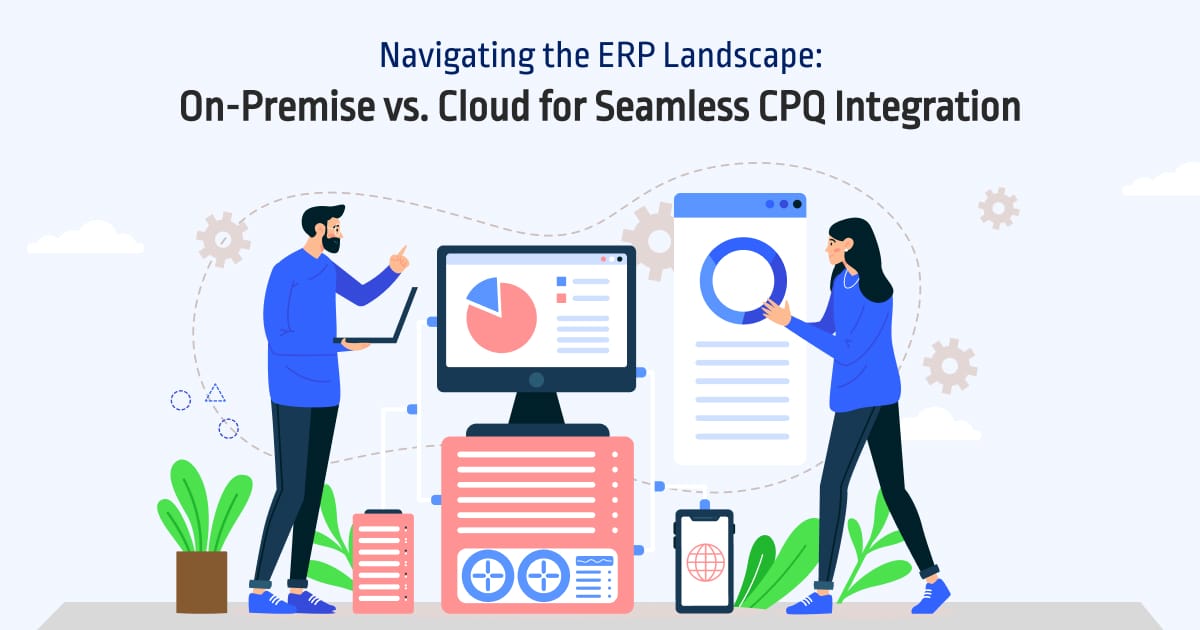
Navigating the ERP Landscape: On-Premise vs. Cloud for Seamless CPQ Integration
Manufacturing companies are facing a critical decision that impacts their entire sales operation: should they integrate their CPQ (Configure, Price, Quote) software with cloud-based ERP systems or stick with traditional on-premise ERP solutions? This choice affects everything from quote accuracy to customer satisfaction, making it one of the most important technology decisions for modern manufacturers.
The stakes are high. Companies with properly integrated ERP-CPQ systems process quotes 67% faster and achieve 23% fewer pricing errors than those using disconnected solutions. But the path forward isn’t always clear, especially when weighing the benefits of cloud ERP solutions against the control of on-premise ERP systems.
Why Is ERP-CPQ Integration So Critical for Manufacturing Success?
Before diving into the cloud versus on-premise debate, it’s essential to understand why this integration matters so much. Your ERP system contains the lifeblood of your manufacturing operation: real-time inventory levels, accurate pricing structures, detailed product configurations, and comprehensive customer data. Meanwhile, your CPQ software needs instant access to this information to generate accurate quotes quickly.
When these systems aren’t properly integrated, the consequences are immediate and costly:
| Impact Area | Without Integration | With Proper Integration |
|---|---|---|
| Quote Processing Time | 4-6 hours per complex quote | 1-2 hours per complex quote |
| Pricing Accuracy | 77% accuracy rate | 95%+ accuracy rate |
| Sales Productivity | 30% time on admin tasks | 10% time on admin tasks |
| Customer Satisfaction | 68% satisfaction score | 89% satisfaction score |
| Revenue Loss | 15-20% potential revenue | 2-5% potential revenue |
Manufacturing companies report losing 15-20% of potential revenue due to quote delays and pricing errors. Sales teams waste hours manually transferring data between systems, creating opportunities for human error and customer frustration.
The most successful manufacturers understand that ERP-CPQ integration isn’t just about connecting two software systems; it’s about creating a seamless flow of information that empowers sales teams to respond faster, quote more accurately, and ultimately win more business.
Streamline Operations & Drive Smarter Growth
Looking to optimize workflows, reduce inefficiencies, and scale faster? Discover how GrexPro’s intelligent solutions can transform the way your business works.
On-Premise ERP: Is the Control Worth the CPQ Integration Price?
For decades, on premise ERP systems were the industry standard. Installed and maintained directly on a company’s own servers, they offered unparalleled control and deep customization capabilities.
Key Characteristics & Impact on CPQ Integration:
- Unrivaled Customization:
For manufacturers with highly unique, legacy processes, an on premise ERP can be tailored precisely to specific operational demands. This can allow for deeply bespoke integrations with a CPQ, though often at a high development cost. - Full Data Sovereignty:
All your critical data resides within your physical control, which can be a strong draw for businesses with stringent internal security policies or regulatory compliance requirements. - Predictable Long-Term Costs (Post-Investment):
After the substantial initial investment in hardware, software licenses, and implementation, ongoing costs primarily involve maintenance, upgrades, and dedicated IT staff.
However, this control often comes with significant drawbacks when considering modern CPQ integration:
- High Upfront Capital Expenditure:
Requires substantial initial investment in servers, software licenses, and the personnel needed for implementation and ongoing management. - Complex Maintenance & Upgrades:
Your IT team is responsible for all patching, security updates, and major version upgrades. Integrating new CPQ features or updating the CPQ often necessitates complex and time-consuming modifications to the on premise ERP, leading to delays and potential system instability. - Scalability Challenges:
Expanding or contracting IT resources with an on premise ERP is a slow, expensive process, making it less agile for businesses experiencing rapid growth or fluctuating demand. - Integration Hurdles:
Connecting modern, agile cloud-based CPQ solutions with older, potentially rigid on premise ERP systems can be technically challenging. It often demands custom APIs, middleware, and extensive development efforts, increasing both initial project costs and long-term maintenance burdens.
Unlock Faster Quoting: How Cloud ERP Drives CPQ Agility and Scalability
Cloud ERP, encompassing cloud-based ERP software, cloud-based ERP systems, and cloud ERP solutions, has become the dominant choice for forward-thinking manufacturers. These systems are hosted by a third-party provider and accessed securely via the internet, fundamentally changing how businesses manage their resources.
Key Characteristics & Impact on CPQ Integration:
- Lower Upfront Investment & Predictable Operating Costs:
Moves IT from a capital expense to a more predictable operational expense through subscription-based pricing. This frees up capital for other strategic investments. - Unmatched Scalability & Flexibility:
Easily scale computing resources up or down based on your business needs. This agility is invaluable for manufacturers with seasonal demand or aggressive growth plans, directly benefiting CPQ performance by ensuring underlying system capacity. - Automated Maintenance & Updates:
The cloud vendor manages all system maintenance, security patches, and major upgrades. This means your ERP, and by extension your CPQ integration, is always leveraging the latest features and security protocols without burdening your internal IT team. - Enhanced Accessibility & Collaboration:
Access your ERP and integrated CPQ from anywhere, on any device with an internet connection. This empowers remote sales teams and improves cross-departmental collaboration, a critical factor for global manufacturing operations. - Streamlined Integration Ecosystem:
Modern cloud ERP solutions are designed with open APIs and robust integration frameworks. This makes connecting with other best-of-breed cloud applications, such as advanced CPQ software, significantly more straightforward and less costly. This is where the inherent flexibility of a solution like GrexPro CPQ truly comes into its own, simplifying complex integrations.
Considerations for Cloud ERP
- Internet Dependency: A stable and reliable internet connection is essential for continuous access.
- Customization vs. Configuration: While highly configurable, cloud ERPs might offer less deeply bespoke customization compared to a completely custom-built on premise ERP. However, for the vast majority of manufacturing businesses, the extensive configuration options provided are more than sufficient.
- Data Security (Perception vs. Reality): While some businesses initially have concerns about data residing off-site, reputable cloud providers invest massively in cybersecurity, often exceeding the capabilities of individual companies.
Cloud vs. On-Premise ERP: Making the Right Choice for Your CPQ
The decision between an on premise ERP and a cloud ERP for optimal CPQ integration is a pivotal strategic choice. To help you evaluate, consider these crucial factors:
| Feature/Aspect | On-Premise ERP | Cloud ERP | Impact on CPQ Integration |
|---|---|---|---|
| Cost Structure | High upfront capital expenditure | Lower upfront, subscription-based operational cost | Cloud enables faster ROI for CPQ, on-premise demands significant initial IT budget. |
| Scalability | Slow, costly, and complex to scale | Highly agile and cost-effective to scale up/down | Cloud supports rapid business growth & fluctuating demand for CPQ. |
| Maintenance & IT | Internal IT team responsible; high burden | Vendor handles maintenance, updates, security | Cloud frees IT for strategic projects, ensuring up-to-date integration. |
| Accessibility | Limited to internal network/VPN | Anywhere, anytime access via internet | Cloud enhances sales team mobility & collaboration. |
| Integration Ease | Can be complex, requires custom APIs/middleware | Generally easier with open APIs, native connectors | Cloud often streamlines integration with modern CPQ tools. |
| Customization | Very high, deep bespoke modifications possible | High configuration, less deep customization | On-premise can be tailored for unique legacy processes, cloud for agile standardized best practices. |
| Speed of Deployment | Longer implementation cycles | Faster deployment and time-to-value | Cloud gets your integrated CPQ up and running quicker. |
Beyond these technical comparisons, a truly strategic decision requires an honest assessment of your unique business landscape. Ask your team:
- IT Readiness & Resources: Does your internal IT team possess the bandwidth and specialized expertise to manage, secure, and continuously update a complex on premise ERP and its integrations? Or would offloading infrastructure management to a cloud provider free up valuable resources for innovation?
- Financial Strategy: Are you structured for significant capital expenditures on infrastructure, or do you prefer the agility and predictable operational costs of a subscription-based model?
- Growth Trajectory & Agility: How quickly do you anticipate scaling your operations or adapting to market shifts? Will your chosen ERP empower your CPQ to scale rapidly alongside your business, or will it become a bottleneck?
- Process Uniqueness vs. Standardization: Are your manufacturing processes so proprietary they demand deep, bespoke ERP customization that only an on premise ERP can provide? Or can your unique needs be met through the extensive configuration options of modern cloud ERP solutions paired with a flexible CPQ like GrexPro?
- Long-Term Technology Vision: Is your organization already embracing cloud adoption across other departments? Aligning your ERP with a broader cloud strategy can create a more cohesive and efficient digital ecosystem, crucial for future-proofing your CPQ.
Your ultimate goal isn’t just to choose an ERP; it’s to select a foundation that acts as a powerful accelerator for your CPQ. An ERP that seamlessly feeds real-time, accurate data to your sales team empowers them to configure, price, and quote with unmatched speed, precision, and confidence, directly impacting your bottom line and driving competitive advantage.
Ready to transform your business operations?
Discovr how our comprehensive solutions can streamline your workflows, boost productivity, and drive sustainable growth.
GrexPro: ERP-Agnostic CPQ for Manufacturing Excellence
The excellent news for manufacturers is that modern CPQ solutions are designed with remarkable flexibility and integration in mind. At GrexPro, we deeply understand that manufacturing operations utilize a diverse range of ERP systems – from well-established on prem ERP instances to cutting-edge cloud based ERP solutions.
This is why GrexPro CPQ is built to be truly ERP-agnostic. Our platform is engineered for seamless integration with a wide array of ERP systems, regardless of whether they are on-premise or cloud based. This unique flexibility allows you to leverage your existing ERP investment while simultaneously unlocking the full transformative power of advanced CPQ features.
How GrexPro Ensures Seamless Integration
- Robust, Configurable APIs: Our platform utilizes flexible APIs that allow for efficient data exchange with virtually any ERP system, minimizing the need for complex custom coding.
- Data Synchronization: We ensure real-time or near real-time synchronization of critical data points – product catalogs, pricing rules, inventory levels, customer master data, and order statuses – between your ERP and CPQ.
- Eliminating Manual Bottlenecks: GrexPro streamlines the entire quote-to-order process, reducing manual data entry and potential errors, and improving overall efficiency.
- Future-Proofing Your Sales Process: Our commitment to an ERP-agnostic approach means your CPQ solution can adapt as your ERP strategy evolves, protecting your investment.
By choosing an ERP that integrates flawlessly with a powerful CPQ like GrexPro, you don’t just generate quotes faster; you create a unified operational backbone. This empowers your sales, engineering, and manufacturing teams to collaborate effortlessly, reducing lead times, improving order accuracy, and boosting profitability. Explore the extensive GrexPro CPQ Features to see how our capabilities directly enhance the data within your chosen ERP.
Conclusion: Powering Your Manufacturing Future with Integrated CPQ
The decision between an on-premise and cloud ERP for seamless CPQ integration is a strategic one, impacting everything from your IT budget to your competitive agility. While on premise ERP offers deep control, cloud ERP solutions increasingly provide the agility, scalability, and streamlined integration capabilities that modern manufacturers need to thrive.
Regardless of your ERP environment, partnering with a CPQ provider that prioritizes flexible and robust integration is paramount. GrexPro is dedicated to helping manufacturers achieve truly seamless CPQ-ERP integration, transforming their sales and quoting processes into a powerful competitive advantage. We invite you to discover how GrexPro CPQ Software can revolutionize your sales cycle and manufacturing operations.
Ready to explore how GrexPro can integrate with your existing ERP to unlock new levels of efficiency, accuracy, and growth? Contact us Today to schedule a personalized consultation or learn more about our innovative solutions at GrexPro.com.
Frequently Asked Questions
How does cloud ERP improve CPQ performance?
Cloud ERP improves CPQ performance by providing a highly scalable, flexible, and accessible platform. Its inherent agility allows for faster data synchronization, robust APIs for easier integration, and automated maintenance/updates, ensuring that your CPQ always operates with the most current and accurate data. This leads to quicker quote generation and improved sales efficiency.
What are the pros and cons of on-premise ERP for CPQ?
On-premises ERP pros for CPQ include maximum control over data and customization. Cons involve high upfront costs, complex and resource-intensive maintenance, slower scalability, and potentially more challenging integrations with modern cloud-based CPQ solutions.
Can CPQ software work with any ERP system?
Most modern CPQ software, including GrexPro CPQ, is designed to be ERP-agnostic, meaning it can integrate with a wide range of ERP systems, both on-premise and cloud-based. However, the ease and depth of integration can vary depending on the ERP's age, architecture, and available APIs.
Which ERP systems offer the best compatibility with CPQ tools?
Generally, cloud-based ERP systems with open APIs and modern integration frameworks (e.g., SAP S/4HANA Cloud, Oracle Cloud ERP, Microsoft Dynamics 365, NetSuite) offer the best out-of-the-box compatibility with CPQ tools. However, a flexible CPQ solution like GrexPro is designed to integrate effectively across various ERP environments.
How do I choose between cloud and on-premise ERP for CPQ?
To choose between cloud and on-premise ERP for CPQ, evaluate your budget, IT resources, scalability needs, desired level of control and customization, and long-term strategic goals. Cloud ERP often suits businesses prioritizing agility and lower operational costs, while on-premise is for those needing absolute data control and highly bespoke system modifications.

 Surendra Yarrum